Showing posts with label Kylie McDaniels. Show all posts

Saturday, February 28, 2015

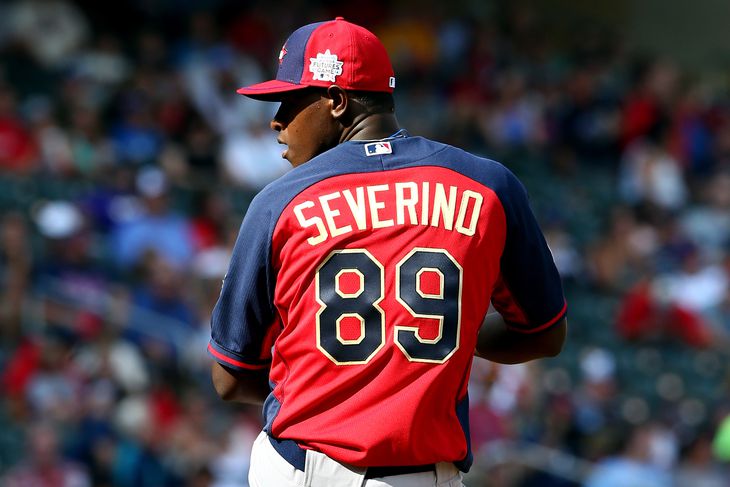
Greedy Pinstripes Top 28 Prospects List: Luis Severino


Luis Severino is the Top and best Yankees prospect. Everyone knew it coming in and everyone knows it now. I won't build it up because everyone knows the deal. Congratulations to Severino. 

Here is the write up from Kyle McDaniel on Severino:


Current Level/Age: AA/20.9, 6’0/195, R/R
Signed: IFA at age 17 on December 26, 2011 out of Dominican Republic by NYY for $225,000 bonus
Fastball: 65/70, Slider: 40/50+, Changeup: 50/60, Command: 40/50

Scouting Report: Severino wasn’t a high profile signing, but stood out to me in instructs the fall after his 2012 stint in the Dominican Summer League. He sat 92-94 mph in both outings I saw and threw a solid average slider, but didn’t work in a changeup and his delivery/command needed work. That said, he was a loose athlete and definitely an arm to watch; many big league arms looked like this at age 18. Clips from these two 2012 instructs outings are at the end of the video while the beginning and bulk of the video is from a 2014 instructs outing.

In the two year interim between the video clips, Severino grew from his listed 6’0/195, getting a little taller, stronger and generally more physically mature. In the 2012 video, his mechanics needed work and in 2014 he’s made almost all the necessary adjustments: he was more upright at release with a shorter stride, worse posture at release and this inefficiency led to less explosion, less stuff and less command.Severino Load
Severino was mostly 91-95 mph in 2013 and early in 2014, then got stronger as the year went on, flashing 94-97 mph heat at times later in the year and sustaining it for innings. For about 40 pitches in the 2014 instructs in the video, he sat 94-97, with no fastball below 93 mph. It’s obvious that maturing physically and mechanically in those two years is a positive indicator, but one of the things that stood out to me from the beginning with Severino is how quickly he loads his arm. In the picture to the right, you can see his arm in the loaded position with his foot still a couple frames from hitting the ground.
I’m not a doctor, but the short version is that if that when the front foot plants and the hips are about to explode toward the plate, if the arm isn’t in the right place, the body takes it along for a ride anyway. 

So, if the arm isn’t ready yet, it goes sailing through the throwing motion with lots of stress, which is really bad, both for command and health. Many relievers create arm speed by doing this and that’s part of the reason they get injured so often and typically have bad command.
This sort of thing happens more often with a high effort delivery and Severino’s is pretty easy, though there’s a little stiffness in the finish at times. I don’t usually break down mechanics like this, but throwing 94-97 mph regularly with some command and not cheating via loading the arm late is very rare.  It bodes well for health and usually is seen in pitchers with “pure” velocity and quick-twitchiness and they’re often starting pitchers, like Yordano Ventura and Pedro Martinez. Pedro is an all-timer, but multiple Yankee execs mentioned Ventura as a comparable for Severino, though they were quick to caution to not raise expectations too high. Yankee fans would never do that, though.

Severino took quickly to using a changeup regularly after arriving in America, developing it as a plus pitch in about a year of using it, though it can sometimes play to 55 on certain days, as he’s still developing consistent control of his off-speed offerings. His slider is still a third pitch, but it flashes 55 at times. The concern is that he’s throwing one pitch and, in the 2014 outing in the video, the velocity of it ranged from 82-91 mph, looking like a cutter, slider and a hybrid third pitch between them. He “accidentally” threw a 91 mph pure cutter one time in the outing that was plus, further underlining the arm talent but lack of feel for how to consistently spin the above average breaker that he clearly has in there somewhere.

Summation: Severino should spend 2015 in the upper levels of the minors and be ready for a big league audition either late in 2015 or at some point in 2016; that’ll likely depend on his performance and the needs of the big club. There’s still some markers here that make some scouts say reliever and that may be how he breaks into the big leagues, but the Yankees see starter all the way. Severino’s ability to make adjustments to his delivery and repertoire along with the good health indicators of his delivery suggest he’ll figure out a way to stay in the rotation, with the upside of a #2 starter and realistic outcome of closer or #3 starter. For reference, scouts think there are 8-12 number one starters at any given time (5+ WAR) and maybe 15-20 number two’s (4 WAR); these numbers are a guide rather than a rule.

FV/Role/Risk: 60, #3 starter, Medium (3 on 1-5 scale)
Projected Path: 2015: AA/AAA, 2016: AAA/MLB

1. Luis Severino
2. Aaron Judge
3. Greg Bird
4. Jorge Mateo
5. Robert Refsnyder
6. Gary Sanchez
7. Jacob Lindgren
8. Ian Clarkin
9. John Ryan Murphy
10. Luis Torrens
11. Tyler Austin
12. Bryan Mitchell
13. Miguel Andujar
14. Eric Jagielo
15. Jake Cave
16. Austin DeCarr
17. Tyler Wade
18. Juan DeLeon
19. Dante Bichette Jr.
20. Domingo German
21. Slade Heathcott
22. Nick Rumbelow
23. Jose Ramirez
24. Ramon Flores
25. Gosuke Katoh
26. Chasen Shreve
27. Taylor Dugas

28. Johnny Barbato

Friday, February 27, 2015

Greedy Pinstripes Top 28 Prospects List: #2


This is the part of the list where it gets a bit anti-climatic. The Top Two Yankees Prospects. I think we all know it is going to be some combination of Aaron Judge and Luis Severino and I think 99 lists out of 100 will have Judge in this #2 spot, including my list. Aaron Judge is the Yankees second best prospect on my list. 

Here is the write up from Kyle McDaniel on Judge:


Current Level/Age: High-A/22.7, 6’7/250, R/R
Drafted: 32nd overall (1st round) in 2013 out of Fresno State by NYY for $1.8 million bonus, Agency: PSI Sports Mgmt
Hit: 20/50, Raw Power: 70/70, Game Power: 20/60, Run: 50/45, Field: 50/50, Throw: 60/60

Scouting Report: I saw Judge in his junior year at Fresno State, which you can pretty easily pick out of the video above by uniform colors. I thought he was incredibly talented, but the Giancarlo Stanton comps were ridiculous, as Judge was struggling to perform close to his potential in college at age 21, while Stanton already had about 50 big league homers at that age. The Stanton comps are still ridiculous for the same reason, but, physically speaking, it’s hard to find a comp. Judge is 6’7/250, is a solid average runner underway with a plus arm and plus-plus raw power. Scouts were resorting to comparing Judge to basketball players (LeBron James and Blake Griffin were common ones) to find someone other than Stanton even remotely similar.

In the weekend I saw Judge face Stanford, we was a non-factor at the plate Friday versus 2013 #1 overall pick Mark Appel (on one of the best stuff days of Appel’s life) was just okay on Saturday, then went 5-for-5 with four singles and a massive homer (included on the above video) on Sunday against the weakest pitching of the weekend. I recount that weekend because there were a couple GMs are about 10 scouting directors there that weekend and it encapsulated the amateur experience of scouting Judge: mostly struggled against top arms, excelled against weaker arms and didn’t hit for enough power in games.  These struggles weren’t because he didn’t have the bat speed of physical ability to hit amateur pitching, but his long limbs obviously created contact problems, which is a big reason why there aren’t many 6’7 hitters in the big leagues.

Judge would shorten up to hit singles in college and scouts began to wonder if he could consistently hit for some kind of game power and make enough contact at the same time, which is why he slid to the end of the first round. There were whispers he was stubborn and un-coachable or other various mental explanations for not tapping into his raw ability. Multiple clubs I talked to didn’t have him anywhere close to the first round and some area scouts turned him in as a middle round pick. The Yankees had three first round picks at the end of the round and know that most 45 or 50 FV big league players don’t really move the needle for them, so they were in a position to take a risk and Judge was on the board, as they hoped he would be.

After signing late and sustaining a quad injury that kept him from playing in the regular season, 2014 was Judge’s first pro experience and he has smashed mine and everyone else’s expectations. Some scouts wondered how quickly or if Judge would get out of A-Ball and, this year, he smoked Low-A and High-A for a combined .308/.419/.486 with 17 homers and 89 walks in 543 PA, then raked in the Arizona Fall League: .278/.377/.467 over 106 PA.
He still isn’t completely tapping into his raw power, but no one saw him hitting for good average/on-base and 21 homers in his first full season unless it was all taking place at Low-A. Yankees development people keep telling me that they aren’t responsible for making any notable changes to his swing when I ask what was different this year from past years. The Yankees let kids do it his way in his first season, then they can then make adjustments if things don’t work. It suggests something at Fresno State wasn’t right that Judge is performing so well by dictating his offensive development.

I put his hit/game power grades at 5 and 6, but if Judge can continue this performance at the upper levels, both grades may be a notch light. He’s making adjustments and Yankees’ personnel are all praising his work ethic, makeup and ability to know what’s necessary for him to succeed. The phrase “we just stay out of his way” was thrown around by a couple sources and it seems to be working so far.

Summation: Judge will head to Double-A next year at age 23 and should be challenged, but likely will also get a taste of Triple-A, where he’ll be age appropriate for a top prospect after taking a little while to get going at the plate. If he keeps hitting, he should be in line for an extended big league look in 2016, with a chance for a 2015 September look or a slower path with him sticking by 2017. We haven’t yet found the limits of what Judge can do and he hasn’t even really tapped into his raw power in games yet, so he could struggle at the upper levels or just keep proving scouts wrong.

Upside: .270/.340/.490, 30 homers
FV/Risk: 55, Medium (3 on a 1-5 scale)
Projected Path: 2015: AA/AAA, 2016: AAA/MLB, 2017: MLB

1.
2. Aaron Judge
3. Greg Bird
4. Jorge Mateo
5. Robert Refsnyder
6. Gary Sanchez
7. Jacob Lindgren
8. Ian Clarkin
9. John Ryan Murphy
10. Luis Torrens
11. Tyler Austin
12. Bryan Mitchell
13. Miguel Andujar
14. Eric Jagielo
15. Jake Cave
16. Austin DeCarr
17. Tyler Wade
18. Juan DeLeon
19. Dante Bichette Jr.
20. Domingo German
21. Slade Heathcott
22. Nick Rumbelow
23. Jose Ramirez
24. Ramon Flores
25. Gosuke Katoh
26. Chasen Shreve
27. Taylor Dugas

28. Johnny Barbato

Thursday, February 26, 2015

Greedy Pinstripes Top 28 Prospects List: #3


The Top Three Prospects in the Yankees system according to The Greedy Pinstripes, get hyped! Today our third prospect is revealed and his name is Greg Bird. I may be a little high on Bird as a first baseman and I worry about his back as much as anyone but the guy is close to the majors and can flat out hit. If you don't believe me see his Arizona Fall League stats from 2014. 


Here is the write up from Kyle McDaniel on Bird:


Current Level/Age: AA/22.2, 6’3/215, L/R
Drafted: 179th overall (5th round) in 2011 out of Colorado HS by NYY for $1.1 million bonus, Agency: Legacy
Hit: 20/50+, Raw Power: 60/60, Game Power: 20/60, Run: 35/35, Field: 40/45+, Throw: 50/50+

Scouting Report: Bird has been an under-the-radar prospect in a high profile system, but had a breakout year in 2014 after getting on the radar with a strong full-season debut in 2013. Bird was an overpay (for a surprisingly high amount, to the industry) in the 5th round out of a Colorado high school, so we’re talking about a high school first baseman (who caught at times, but everyone knew that wouldn’t work) with limited physical projection from a cold weather state without great competition.

He was banged up and just alright after signing and in short-season leagues/instructs in 2012, then hit way more than expected in Low-A in 2013: .228/.428/.511 with 20 homers as a 20-year-old. Bird still has a good arm from his catching days that was enough for the Yankees to consider letting him catch after he signed, until a back injury nixed that idea. He moves pretty well around the bag and is fine defensively, but it’s all about the bat here.
I got reports that Bird looked like a young, healthy version of Nick Johnson, but given just one season of performance with little background and the limits of a first base profile, scouts were still cautious. Bird performed well above league average while aged correctly for a prospect in High-A in 2014 (making for a scary middle of the lineup with Judge), then hit even better in a late-season Double-A promotion and carried that level of performance to the Arizona Fall League.

Bird has an advanced feel for the strike zone and is more of a hitter who has power than a slugger that swings from his heels. One way that scouts pick up on this is that Bird will not show you all of his raw power in BP. I’ve seen Bird take BP at least a half dozen times and, while Judge will let it loose in the last round and Gary Sanchez tries to put a hole in the outfield wall in most of his BP swings, Bird will just hit line drives all over the field with every swing. I’ve seen him hit homers in games to all parts of the ballpark and seen him carry the center field wall by 30 feet. It’s plus power and it might be a 65, I just haven’t seen it in BP to confirm. I also couldn’t get this out of my head when writing this report.

Summation: Bird will head to the upper levels for 2015 and, like Judge, if he keeps mashing may be a big league option by the end of 2015. More conservatively, there will be some challenges and things to work on and the ETA is likely sometime in 2016.

Upside: .275/.360/.470, 25 homers
FV/Risk: 50, Low (2 on a 1-5 scale)
Projected Path: 2015: AA/AAA, 2016: AAA/MLB

1.
2.
3. Greg Bird
4. Jorge Mateo
5. Robert Refsnyder
6. Gary Sanchez
7. Jacob Lindgren
8. Ian Clarkin
9. John Ryan Murphy
10. Luis Torrens
11. Tyler Austin
12. Bryan Mitchell
13. Miguel Andujar
14. Eric Jagielo
15. Jake Cave
16. Austin DeCarr
17. Tyler Wade
18. Juan DeLeon
19. Dante Bichette Jr.
20. Domingo German
21. Slade Heathcott
22. Nick Rumbelow
23. Jose Ramirez
24. Ramon Flores
25. Gosuke Katoh
26. Chasen Shreve
27. Taylor Dugas

28. Johnny Barbato

Wednesday, February 25, 2015

Greedy Pinstripes Top 28 Prospects List: #4


We're into the Top Four ladies and gentleman. Top Four Yankees Prospects. This is bitter sweet because I never want Prospects Month to end but it's also an absolute ton of work. It's worth it though. Anyway, the Yankees fourth best prospect on our list is none other than Mr. Jorge Mateo!


Here is the write up from Kyle McDaniel on Sanchez:


Current Level/Age: RK/19.6, 6’0/190, R/R
Signed: IFA at age 16 on January 28, 2012 out of Dominican Republic by NYY for $250,000

Hit: 20/50+, Game Power: 20/45, Raw Power: 45/45+, Speed: 80/80, Field: 45/55, Throw: 55/55

Scouting Report: The Dominican shortstop was a low profile signings in January 2012 and jumped on the prospect scene this season with a breakout stateside debut in the GCL.  Mateo has grown an inch and added 25-30 pounds since signing and 2014 wasn’t even his first strong performance: he hit 7 homers and stole 49 bases in 299 plate appearances in the Dominican Summer League in 2013.  Scouts were telling me about Mateo early in the GCL season with his 80 speed attracting a lot of attention, but his breakout GCL season was ended early by a broken finger. I didn’t see Mateo until instructional league in Tampa, which is where the above video was shot.

Mateo runs a 4.0 in the first clip of the above video; a top-of-the-scale 80 time on the 20-80 scouting scale. He exceeded my expectations by showing true 80 speed and enough arm, range and hands to have a real chance to stick at shortstop with a surprising amount of pop in batting practice.  Still just 19, Mateo was more than just a live body with some bat speed, showing surprising feel at the plate by working counts and battling against pitchers years older than him.

Given his age and low level of competition so far, there’s still some risk and things for him to work on. He’s good defensively but isn’t a the super-smooth Gold Glove type, so he’ll need to continue to hone his instinct and footwork, but the tools are there to be a solid defender. Mateo loads his hands a little too high and his foot is often off the ground at contact (both fixable issues), but he has the bat control and feel for his swing to make a healthy cut work.  He should probably shorten his swing a bit from his current Alfonso Soriano-type cut, but there’s a lot of talent here, so you don’t want to interfere with it too much.

Summation: Mateo likely heads to Low-A next year in what will be one of the most anticipated full-season debuts in baseball due to his buzz, upside and lack of experience stateside.

Upside: .285/.350/.440, 12-15 homers, plus plus base running, solid average defense
FV/Risk: 50, High (4 on a 1-5 scale)
Projected Path: 2015: Low-A, 2016: High-A, 2017: AA/AAA, 2018: AAA/MLB

1.
2.
3.
4. Jorge Mateo
5. Robert Refsnyder
6. Gary Sanchez
7. Jacob Lindgren
8. Ian Clarkin
9. John Ryan Murphy
10. Luis Torrens
11. Tyler Austin
12. Bryan Mitchell
13. Miguel Andujar
14. Eric Jagielo
15. Jake Cave
16. Austin DeCarr
17. Tyler Wade
18. Juan DeLeon
19. Dante Bichette Jr.
20. Domingo German
21. Slade Heathcott
22. Nick Rumbelow
23. Jose Ramirez
24. Ramon Flores
25. Gosuke Katoh
26. Chasen Shreve
27. Taylor Dugas

28. Johnny Barbato