Showing posts with label Cour Four. Show all posts

Tuesday, August 22, 2017

Remembering Yankees of the Past: Jorge Posada

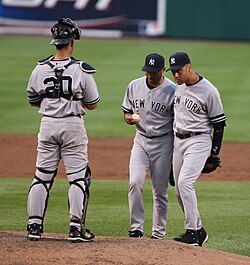
As we learned or remembered on This Day in Yankees History this morning it was this day in 2015 that the New York Yankees honored their long-time catcher Jorge Posada with Jorge Posada Day at the stadium. Posada's #20 was retired and a plaque was placed in Monument Park to honor him. With this day one year ago in mind let's remember a great Yankee of the past. Hip Hip, Jorge!

Here is my post from 2015 from Jorge Posada Day:



Welcome ladies and gentleman to Jorge Posada Day! Jorge Rafael Posada Villeta was born on August 17, 1971 in Santurce, San Juan, Puerto Rico to Tamara and Jorge Posada Sr. Posada spent 17 seasons in Major League Baseball, all with the New York Yankees, and helped open the door for the offensive minded catcher along with the New York Mets catcher Mike Piazza. Posada finished his career with a .273 batting average, 275 home runs and 1,065 RBI as a switch hitting catcher. Jorge was a five-time All-Star, five-time Silver Slugger Award winner and received four World Series rings as a member of the Yankees. Posada wasn't always the man we see before us today, at one time even Jorge Posada was a prospect.


Posada attended Alejandrino High School in San Juan where he not only played baseball for the school but other sports as well. Posada was a shortstop in High School and did enough in his time there to earn a scholarship from Calhoun Community College in Decatur, Alabama. CCC recruited Posada without even scouting him and Posada accepted the scholarship without even visiting the school after his SAT scores kept him from going to a traditional four-year college. Posada was voted the best hitter in his first season, 1990, while earning the co-captain position as well. Posada's bat, rifle arm and attitude was enough to earn the attention of the New York Yankees who drafted him in the 24th round of the 1990 Major League Baseball First Year Players Draft. Posada signed for roughly $30,000 on a three year deal.


Posada began his Yankees career as a second baseman but the team feared that he lacked the speed to remain as an infielder so the team began the move from second base to catcher in 1992. Posada was not happy about the transition reportedly but after a bumpy beginning he agreed to it and ended up flourishing at the plate while catching some lanky lefty named Andy Pettitte for the first time that season. In his first full season as a catcher Posada hit 17 home runs and knocked in 61 RBI in 118 games garnering a promotion to Double-A. Posada's defense behind the plate needed work, he committed 38 passes balls in 1993, his bat was good enough to earn a promotion to Triple-A with the Columbus Clippers for the 1994 season. Posada's season started out well as he had 11 home runs before a collision at home plate broke his left leg, dislocated his ankle and prematurely ended his 1994 season. Posada was recovered from the ankle injury in 1995 and found himself almost immediately in the middle of multiple trade discussions.


The Yankees attempted to trade Posada to the Seattle Mariners for Tino Martinez before those talks fell apart. Just three weeks later the Yankees attempted to trade Jorge Posada and Mariano Rivera to the Cincinnati Reds for David Wells but thankfully the Cincinnati GM turned the deal down. Deals like this is what makes me wonder why people state that they want George Steinbrenner back or GM's like Gene Michael running the team again. This also goes to show you how GM's, managers and owners simply get lucky sometimes but that is another discussion for another post I guess.


Posada was called up to the Major Leagues in 1995 and made his MLB debut replacing Jim Leyritz in a game on September 4, 1995. Posada was included on the postseason roster despite that debut marking his only game in the bigs and even allowed him into Game 2 of the 1995 American League Division Series as a pinch runner. Posada was back in Triple-A in 1996 before being added back to the roster as a September call up. Posada lasted just eight games in 1996 and was added to the postseason roster once again. Posada did not appear in the postseason in 1996 but he earned his first World Series ring in 1996 when the Yankees beat the Atlanta Braves in six games.


Posada was handed the backup catcher position in the 1997 season as he quickly became the student of starting catcher Joe Girardi. Posada appeared in 60 games that season before their season was ended prematurely by the Cleveland Indians in the 1997 ALDS. Once again in 1997 the Yankees offered Posada in a deal along with Mike Lowell for Pedro Martinez of the Montreal Expos. Martinez was ultimately traded to the Boston Red Sox instead as the Yankees once again dodged a bullet with their soon to be starting catcher. Posada used the trade rumors as motivation for the 1998 season and it seemingly worked as he finished the season with a .268 batting average, 17 home runs and 63 RBI while catching David Wells perfect game on May 17. Another season, another postseason and another ring for Posada, his second of his career.

Posada split time with Girardi in 1999 as well and once again won a World Series ring with the Yankees as he slowly saw his playing time increase. Girardi left the Yankees as a free agent before the 2000 season allowing Posada to become the full-time catcher in the Bronx. Posada made his first All-Star Game appearance after hitting .287 with 28 home runs and 86 RBI and won his fourth World Series as a member of the Yankees. Posada was right back in the Mid-Summer Classic in 2001 as well and was right back into the World Series as well when he came up one out short of his fifth World Series ring in pinstripes. While Posada didn't reach the World Series in 2002 he did make his third consecutive All-Star Game appearance and got a fourth nod in 2003. Posada was back in the World Series in 2003 after hitting the game tying hit against Pedro Martinez late in Game 7 of the ALCS but the team was unable to stop Josh Beckett and the Florida Marlins in the team's second World Series loss in three seasons. Posada finished the 2003 season in third place of the MVP Award voting behind Alex Rodriguez and Carlos Delgado after hitting .281 with 30 home runs and 101 RBI.


While Posada rode the emotions of the 2003 ALCS after getting the big hit to tie the game he watched in the dugout in the 2004 ALCS when the Boston Red Sox came back from a 3-0 deficit to win the series and eventually their first World Series in 86 seasons. Posada hit free agency after the 2007 season and ultimately turned down a five-year contract offer from the New York Mets before re-signing with the Yankees on a four-year deal worth $52 million. Posada had the security of a large contract in 2007 but in 2008 he had to deal with a disabled list stint for the first time in his career. Posada underwent surgery in his right shoulder to repair a glenoid labrum that ended his season. This season was cut short by injury and was the first time in Posada's career that he did not see his team make the postseason.


Posada entered the 2009 season healthy along with a slew of new teammates and broke in the new Yankee Stadium in a big way hitting the first regular season home run in the stadium. Posada was back from the shoulder surgery and finished the season with a .285 average, 22 home runs and 81 RBI before winning his 5th World Series in a victory over the Philadelphia Phillies. Posada's power was on full display in 2010 as the team looked to defend their crown and even became the first Yankee since Bill Dickey in 1937 to hit grand slams in back-to-back games against the Houston Astros. Posada also collected his 1,000th career RBI but could not collect his 6th World Series ring as the team lost to the Texas Rangers in the 2010 ALCS. Following the 2010 season Posada underwent an arthroscopic surgery in his left knee to repair a torn meniscus that forced him out of the catcher position and into the DH position for the Yankees, something that did not go over well with Posada.


Posada had to watch as the Yankees signed Russell Martin to be their every day catcher and had to watch as former teacher, and current manager, Joe Girardi dropped him to 9th in the Yankees batting order. Posada asked to be removed from the lineup and told reporters he needed to clear his head and also mentioned he had some stiffness in his back as the reasons for asking out of the lineup. Posada was delegated to a bench role in August of 2011 but it earned him one more final trip to the postseason. Posada played well in the ALDS but the team lost the ALCS to the Detroit Tigers in five games as we all watched Posada on the baseball diamond for the final time.


Posada reportedly received interest from five or six teams during the offseason before the 2012 season but the New York Yankees were not one of them. In January of 2012 Posada decided to announce his retirement from the game of Major League Baseball. Posada has rejoined the team as a guest instructor during spring training since his retirement but has rarely been back to Yankee Stadium outside of Derek Jeter Day and Jeter's final game in the Bronx.


Posada is a legend, Yankees or not, and say what you will he deserves this honor of having his number retired by the Yankees. Not many players win five World Series or almost change a position for the better single-handed. Posada is a Yankee and now he will always be remembered as one. Congrats Jorge!

Monday, August 22, 2016

Remembering Yankees of the Past: Jorge Posada

As we learned or remembered on This Day in Yankees History this morning it was this day in 2015 that the New York Yankees honored their long-time catcher Jorge Posada with Jorge Posada Day at the stadium. Posada's #20 was retired and a plaque was placed in Monument Park to honor him. With this day one year ago in mind let's remember a great Yankee of the past. Hip Hip, Jorge!

Here is my post last year from Jorge Posada Day:


Welcome ladies and gentleman to Jorge Posada Day! Jorge Rafael Posada Villeta was born on August 17, 1971 in Santurce, San Juan, Puerto Rico to Tamara and Jorge Posada Sr. Posada spent 17 seasons in Major League Baseball, all with the New York Yankees, and helped open the door for the offensive minded catcher along with the New York Mets catcher Mike Piazza. Posada finished his career with a .273 batting average, 275 home runs and 1,065 RBI as a switch hitting catcher. Jorge was a five-time All-Star, five-time Silver Slugger Award winner and received four World Series rings as a member of the Yankees. Posada wasn't always the man we see before us today, at one time even Jorge Posada was a prospect.


Posada attended Alejandrino High School in San Juan where he not only played baseball for the school but other sports as well. Posada was a shortstop in High School and did enough in his time there to earn a scholarship from Calhoun Community College in Decatur, Alabama. CCC recruited Posada without even scouting him and Posada accepted the scholarship without even visiting the school after his SAT scores kept him from going to a traditional four-year college. Posada was voted the best hitter in his first season, 1990, while earning the co-captain position as well. Posada's bat, rifle arm and attitude was enough to earn the attention of the New York Yankees who drafted him in the 24th round of the 1990 Major League Baseball First Year Players Draft. Posada signed for roughly $30,000 on a three year deal.


Posada began his Yankees career as a second baseman but the team feared that he lacked the speed to remain as an infielder so the team began the move from second base to catcher in 1992. Posada was not happy about the transition reportedly but after a bumpy beginning he agreed to it and ended up flourishing at the plate while catching some lanky lefty named Andy Pettitte for the first time that season. In his first full season as a catcher Posada hit 17 home runs and knocked in 61 RBI in 118 games garnering a promotion to Double-A. Posada's defense behind the plate needed work, he committed 38 passes balls in 1993, his bat was good enough to earn a promotion to Triple-A with the Columbus Clippers for the 1994 season. Posada's season started out well as he had 11 home runs before a collision at home plate broke his left leg, dislocated his ankle and prematurely ended his 1994 season. Posada was recovered from the ankle injury in 1995 and found himself almost immediately in the middle of multiple trade discussions.


The Yankees attempted to trade Posada to the Seattle Mariners for Tino Martinez before those talks fell apart. Just three weeks later the Yankees attempted to trade Jorge Posada and Mariano Rivera to the Cincinnati Reds for David Wells but thankfully the Cincinnati GM turned the deal down. Deals like this is what makes me wonder why people state that they want George Steinbrenner back or GM's like Gene Michael running the team again. This also goes to show you how GM's, managers and owners simply get lucky sometimes but that is another discussion for another post I guess.


Posada was called up to the Major Leagues in 1995 and made his MLB debut replacing Jim Leyritz in a game on September 4, 1995. Posada was included on the postseason roster despite that debut marking his only game in the bigs and even allowed him into Game 2 of the 1995 American League Division Series as a pinch runner. Posada was back in Triple-A in 1996 before being added back to the roster as a September call up. Posada lasted just eight games in 1996 and was added to the postseason roster once again. Posada did not appear in the postseason in 1996 but he earned his first World Series ring in 1996 when the Yankees beat the Atlanta Braves in six games.


Posada was handed the backup catcher position in the 1997 season as he quickly became the student of starting catcher Joe Girardi. Posada appeared in 60 games that season before their season was ended prematurely by the Cleveland Indians in the 1997 ALDS. Once again in 1997 the Yankees offered Posada in a deal along with Mike Lowell for Pedro Martinez of the Montreal Expos. Martinez was ultimately traded to the Boston Red Sox instead as the Yankees once again dodged a bullet with their soon to be starting catcher. Posada used the trade rumors as motivation for the 1998 season and it seemingly worked as he finished the season with a .268 batting average, 17 home runs and 63 RBI while catching David Wells perfect game on May 17. Another season, another postseason and another ring for Posada, his second of his career.

Posada split time with Girardi in 1999 as well and once again won a World Series ring with the Yankees as he slowly saw his playing time increase. Girardi left the Yankees as a free agent before the 2000 season allowing Posada to become the full-time catcher in the Bronx. Posada made his first All-Star Game appearance after hitting .287 with 28 home runs and 86 RBI and won his fourth World Series as a member of the Yankees. Posada was right back in the Mid-Summer Classic in 2001 as well and was right back into the World Series as well when he came up one out short of his fifth World Series ring in pinstripes. While Posada didn't reach the World Series in 2002 he did make his third consecutive All-Star Game appearance and got a fourth nod in 2003. Posada was back in the World Series in 2003 after hitting the game tying hit against Pedro Martinez late in Game 7 of the ALCS but the team was unable to stop Josh Beckett and the Florida Marlins in the team's second World Series loss in three seasons. Posada finished the 2003 season in third place of the MVP Award voting behind Alex Rodriguez and Carlos Delgado after hitting .281 with 30 home runs and 101 RBI.


While Posada rode the emotions of the 2003 ALCS after getting the big hit to tie the game he watched in the dugout in the 2004 ALCS when the Boston Red Sox came back from a 3-0 deficit to win the series and eventually their first World Series in 86 seasons. Posada hit free agency after the 2007 season and ultimately turned down a five-year contract offer from the New York Mets before re-signing with the Yankees on a four-year deal worth $52 million. Posada had the security of a large contract in 2007 but in 2008 he had to deal with a disabled list stint for the first time in his career. Posada underwent surgery in his right shoulder to repair a glenoid labrum that ended his season. This season was cut short by injury and was the first time in Posada's career that he did not see his team make the postseason.


Posada entered the 2009 season healthy along with a slew of new teammates and broke in the new Yankee Stadium in a big way hitting the first regular season home run in the stadium. Posada was back from the shoulder surgery and finished the season with a .285 average, 22 home runs and 81 RBI before winning his 5th World Series in a victory over the Philadelphia Phillies. Posada's power was on full display in 2010 as the team looked to defend their crown and even became the first Yankee since Bill Dickey in 1937 to hit grand slams in back-to-back games against the Houston Astros. Posada also collected his 1,000th career RBI but could not collect his 6th World Series ring as the team lost to the Texas Rangers in the 2010 ALCS. Following the 2010 season Posada underwent an arthroscopic surgery in his left knee to repair a torn meniscus that forced him out of the catcher position and into the DH position for the Yankees, something that did not go over well with Posada.


Posada had to watch as the Yankees signed Russell Martin to be their every day catcher and had to watch as former teacher, and current manager, Joe Girardi dropped him to 9th in the Yankees batting order. Posada asked to be removed from the lineup and told reporters he needed to clear his head and also mentioned he had some stiffness in his back as the reasons for asking out of the lineup. Posada was delegated to a bench role in August of 2011 but it earned him one more final trip to the postseason. Posada played well in the ALDS but the team lost the ALCS to the Detroit Tigers in five games as we all watched Posada on the baseball diamond for the final time.


Posada reportedly received interest from five or six teams during the offseason before the 2012 season but the New York Yankees were not one of them. In January of 2012 Posada decided to announce his retirement from the game of Major League Baseball. Posada has rejoined the team as a guest instructor during spring training since his retirement but has rarely been back to Yankee Stadium outside of Derek Jeter Day and Jeter's final game in the Bronx.


Posada is a legend, Yankees or not, and say what you will he deserves this honor of having his number retired by the Yankees. Not many players win five World Series or almost change a position for the better single-handed. Posada is a Yankee and now he will always be remembered as one. Congrats Jorge!
Tuesday, July 19, 2016

Status update: What does the second of the season hold?

The New York Yankees are at an unusual place in their history as they reach this year’s midseason. The organization is still transitioning from the Core Four era, but ever since the retirements of Bernie Williams, Jorge Posada, Andy Pettitte, Mariano Rivera and finally Derek Jeter, the roster has been interchangeable. The team has tried to replace the players with different levels of success — which begs the questions who are the Yankees and what do they represent at this juncture?

It has not been the Yankee way to fashion a thorough rebuilding of the team from the ground up, since it doesn’t fit with the organization’s win at all costs every year mentality. But maybe now it’s time to throw out the Yankee rulebook and begin anew.

To replace Rivera, the organization employed Rafael Soriano (much to Brian Cashman’s chagrin), then David Robertson, then Dellin Betances and Andrew Miller, and most recently the Miller/Betances/Chapman deadly combination. The Yankees signed Brian McCann after the 2013 season, which also featured Tanaka, Ellsbury, and Beltran joining the organization. The following off-season the Yankees acquired Andrew Miller and Derek Jeter’s replacement, Didi Gregorious.

All of the aforementioned players have had different levels of success with the Yankees, but this observer believes it is time to undergo a full rebuild, instead of an on-the-fly-one. The 2016 Yankees are not good enough for a deep playoff run and unlike the George Steinbrenner-era, it seems the time may have come to sell off assets in order to better the long-term future of the franchise. This way the organization could surround Aaron Judge, Luis Severino, and Greg Bird with other talented assets. And maybe this could the path to anther dynasty era.

Regardless, change is needed.


Saturday, August 22, 2015

Meet a Prospect: Jorge Posada


Welcome ladies and gentleman to Jorge Posada Day! Jorge Rafael Posada Villeta was born on August 17, 1971 in Santurce, San Juan, Puerto Rico to Tamara and Jorge Posada Sr. Posada spent 17 seasons in Major League Baseball, all with the New York Yankees, and helped open the door for the offensive minded catcher along with the New York Mets catcher Mike Piazza. Posada finished his career with a .273 batting average, 275 home runs and 1,065 RBI as a switch hitting catcher. Jorge was a five-time All-Star, five-time Silver Slugger Award winner and received four World Series rings as a member of the Yankees. Posada wasn't always the man we see before us today, at one time even Jorge Posada was a prospect.


Posada attended Alejandrino High School in San Juan where he not only played baseball for the school but other sports as well. Posada was a shortstop in High School and did enough in his time there to earn a scholarship from Calhoun Community College in Decatur, Alabama. CCC recruited Posada without even scouting him and Posada accepted the scholarship without even visiting the school after his SAT scores kept him from going to a traditional four-year college. Posada was voted the best hitter in his first season, 1990, while earning the co-captain position as well. Posada's bat, rifle arm and attitude was enough to earn the attention of the New York Yankees who drafted him in the 24th round of the 1990 Major League Baseball First Year Players Draft. Posada signed for roughly $30,000 on a three year deal.


Posada began his Yankees career as a second baseman but the team feared that he lacked the speed to remain as an infielder so the team began the move from second base to catcher in 1992. Posada was not happy about the transition reportedly but after a bumpy beginning he agreed to it and ended up flourishing at the plate while catching some lanky lefty named Andy Pettitte for the first time that season. In his first full season as a catcher Posada hit 17 home runs and knocked in 61 RBI in 118 games garnering a promotion to Double-A. Posada's defense behind the plate needed work, he committed 38 passes balls in 1993, his bat was good enough to earn a promotion to Triple-A with the Columbus Clippers for the 1994 season. Posada's season started out well as he had 11 home runs before a collision at home plate broke his left leg, dislocated his ankle and prematurely ended his 1994 season. Posada was recovered from the ankle injury in 1995 and found himself almost immediately in the middle of multiple trade discussions.


The Yankees attempted to trade Posada to the Seattle Mariners for Tino Martinez before those talks fell apart. Just three weeks later the Yankees attempted to trade Jorge Posada and Mariano Rivera to the Cincinnati Reds for David Wells but thankfully the Cincinnati GM turned the deal down. Deals like this is what makes me wonder why people state that they want George Steinbrenner back or GM's like Gene Michael running the team again. This also goes to show you how GM's, managers and owners simply get lucky sometimes but that is another discussion for another post I guess.


Posada was called up to the Major Leagues in 1995 and made his MLB debut replacing Jim Leyritz in a game on September 4, 1995. Posada was included on the postseason roster despite that debut marking his only game in the bigs and even allowed him into Game 2 of the 1995 American League Division Series as a pinch runner. Posada was back in Triple-A in 1996 before being added back to the roster as a September call up. Posada lasted just eight games in 1996 and was added to the postseason roster once again. Posada did not appear in the postseason in 1996 but he earned his first World Series ring in 1996 when the Yankees beat the Atlanta Braves in six games.


Posada was handed the backup catcher position in the 1997 season as he quickly became the student of starting catcher Joe Girardi. Posada appeared in 60 games that season before their season was ended prematurely by the Cleveland Indians in the 1997 ALDS. Once again in 1997 the Yankees offered Posada in a deal along with Mike Lowell for Pedro Martinez of the Montreal Expos. Martinez was ultimately traded to the Boston Red Sox instead as the Yankees once again dodged a bullet with their soon to be starting catcher. Posada used the trade rumors as motivation for the 1998 season and it seemingly worked as he finished the season with a .268 batting average, 17 home runs and 63 RBI while catching David Wells perfect game on May 17. Another season, another postseason and another ring for Posada, his second of his career.

Posada split time with Girardi in 1999 as well and once again won a World Series ring with the Yankees as he slowly saw his playing time increase. Girardi left the Yankees as a free agent before the 2000 season allowing Posada to become the full-time catcher in the Bronx. Posada made his first All-Star Game appearance after hitting .287 with 28 home runs and 86 RBI and won his fourth World Series as a member of the Yankees. Posada was right back in the Mid-Summer Classic in 2001 as well and was right back into the World Series as well when he came up one out short of his fifth World Series ring in pinstripes. While Posada didn't reach the World Series in 2002 he did make his third consecutive All-Star Game appearance and got a fourth nod in 2003. Posada was back in the World Series in 2003 after hitting the game tying hit against Pedro Martinez late in Game 7 of the ALCS but the team was unable to stop Josh Beckett and the Florida Marlins in the team's second World Series loss in three seasons. Posada finished the 2003 season in third place of the MVP Award voting behind Alex Rodriguez and Carlos Delgado after hitting .281 with 30 home runs and 101 RBI.


While Posada rode the emotions of the 2003 ALCS after getting the big hit to tie the game he watched in the dugout in the 2004 ALCS when the Boston Red Sox came back from a 3-0 deficit to win the series and eventually their first World Series in 86 seasons. Posada hit free agency after the 2007 season and ultimately turned down a five-year contract offer from the New York Mets before re-signing with the Yankees on a four-year deal worth $52 million. Posada had the security of a large contract in 2007 but in 2008 he had to deal with a disabled list stint for the first time in his career. Posada underwent surgery in his right shoulder to repair a glenoid labrum that ended his season. This season was cut short by injury and was the first time in Posada's career that he did not see his team make the postseason.


Posada entered the 2009 season healthy along with a slew of new teammates and broke in the new Yankee Stadium in a big way hitting the first regular season home run in the stadium. Posada was back from the shoulder surgery and finished the season with a .285 average, 22 home runs and 81 RBI before winning his 5th World Series in a victory over the Philadelphia Phillies. Posada's power was on full display in 2010 as the team looked to defend their crown and even became the first Yankee since Bill Dickey in 1937 to hit grand slams in back-to-back games against the Houston Astros. Posada also collected his 1,000th career RBI but could not collect his 6th World Series ring as the team lost to the Texas Rangers in the 2010 ALCS. Following the 2010 season Posada underwent an arthroscopic surgery in his left knee to repair a torn meniscus that forced him out of the catcher position and into the DH position for the Yankees, something that did not go over well with Posada.


Posada had to watch as the Yankees signed Russell Martin to be their every day catcher and had to watch as former teacher, and current manager, Joe Girardi dropped him to 9th in the Yankees batting order. Posada asked to be removed from the lineup and told reporters he needed to clear his head and also mentioned he had some stiffness in his back as the reasons for asking out of the lineup. Posada was delegated to a bench role in August of 2011 but it earned him one more final trip to the postseason. Posada played well in the ALDS but the team lost the ALCS to the Detroit Tigers in five games as we all watched Posada on the baseball diamond for the final time.


Posada reportedly received interest from five or six teams during the offseason before the 2012 season but the New York Yankees were not one of them. In January of 2012 Posada decided to announce his retirement from the game of Major League Baseball. Posada has rejoined the team as a guest instructor during spring training since his retirement but has rarely been back to Yankee Stadium outside of Derek Jeter Day and Jeter's final game in the Bronx.


Posada is a legend, Yankees or not, and say what you will he deserves this honor of having his number retired by the Yankees. Not many players win five World Series or almost change a position for the better single-handed. Posada is a Yankee and now he will always be remembered as one. Congrats Jorge!

Sunday, December 1, 2013

BP: The Strongest And Weakest Roster Cores of 2013


We’ve gotten fairly good at valuing many aspects of major league player performance, commonly through variants of wins above replacement (WARP or WAR). We’ve also been able to show a compelling connection between the sum of a team’s individual player “wins” and actual team wins in the regular-season standings. What we haven’t done sufficiently, in my opinion, is to appreciate the way that the best teams construct their rosters to maintain those accumulated player wins over time. In other words, it would be nice to have a way to measure how successful teams develop and maintain a “core” of winning players.
Quantifying and understanding the quality of a team’s core is important. As we enter the thick of another baseball offseason, the state of a team’s core dictates whether it can rely primarily on players who are already on the active roster to grow and sustain performance, or whether the team instead needs to raid its farm system—such as it may be—or turn to pricey/volatile free agents.
To be sure, many writers express opinions about teams having a winning “core.” But these opinions tend to be ad hoc, and they also tend to focus on individual players without fairly considering the strength of any roster as a whole. Most importantly, since they’re not based on objective criteria, they do not allow apples-to-apples comparisons of the overall core strength between teams.
It is past time that we devised a way to summarize mathematically the extent to which each team, in a given season, is deriving its success from “core” players.
My solution is called “Core Wins,” and it answers what I think is a three-part question. First, we have to decide what it means to make a “core contribution” to a roster, and how to measure, objectively, the contributions made by different types of players. Second, using the recent achievements of the Tampa Bay Rays as a reference, we’ll decide what levels of core player contributions are significant. Finally, we’ll rank all 30 major league clubs by the strength of their player cores as they proceed through this offseason.
Defining Core Contributions
It goes without saying that a “core” contributor is one who provides positive value to the team. That’s the easy part.
But what transforms a merely “good” or “highly useful” player into a “core” contributor involves two additional factors: the amount of control the player’s team has over him, and the age at which the player is currently playing.
Control is the more important factor. A player under team control for multiple years has more “core” value to his team than a departing free agent. Team control can arise either through baseball’s collective bargaining agreement, which generally provides six years of team control over newly-promoted players, and free agency, by which players with more than six years of roster experience sign contracts with teams of their choosing. Once either type of player has been added to the roster, the source of the team’s control is basically irrelevant, and I do not distinguish between them here.
Age is important as well. Younger players get injured less, will probably improve over time, and are cheaper. Older players, by contrast, play fewer games in a season, trend downward in their performance, and are more expensive. But since the main value of youth is in the guaranteed control it provides, and we are already considering control, age should be weighed less heavily than control in evaluating a player’s “core” value, and that’s what I did here.
So, we have three components: (1) Player Performance, (2) Team Control, and (3) Player Age. Here is how I combined them:
Player Performance
Using the metric of Wins Above Replacement Player (WARP), as currently calculated by Baseball Prospectus, I reviewed the performance of every player during the 2013 baseball season who made a positive overall contribution to his major league club. For pitchers, their batting and pitching WARP were summed. Only players posting positive total WARP figures were considered.
Team Control
Player control numbers were drawn primarily from Cot’s Contracts, and cross-checked with Baseball Reference, other sources, and common sense as needed. Control years were weighted the same, regardless of whether they arose from theCBA or a free agent contract. A player subject to a club option was considered to be under club control for that year. The author’s best estimate of remaining club control was necessary in a few cases when contract details were unclear.
To create a weighting factor for team control, I made two years of control—defined by me as being under contract for the 2013 and 2014 seasons—the baseline. That baseline became the denominator in a fraction I call the Control Index, with the numerator being the actual years of control the team had remaining over a player. So, a player in the last year of his contract would have a Control Index of 0.5, and a player subject to four years of team control would have a Control Index of 2.0. For a variety of reasons, I did not consider the impact of more than five years of team control, so the maximum Control Index that could be applied to a player’s 2013 performance was 2.5.
Player Age Component
To account for player age, I used the generally-accepted peak age of 27 as a numerator. My Age Index was comprised of this peak age divided by each player’s so-called baseball age (their age on July 1, 2013) during the 2013 season. So, a player with a baseball age of 27 would have an Age Index of 1.0. In 2013, the youngest positive contributors in baseball were Manny Machado and Jose Fernandez. At a baseball age of 20, both players had an Age Index of 1.35. The oldest player I found was Andy Pettitte at 41. His Age Index was 0.66. Although baseball players do not approach and decline from their peak age at a uniform rate, I didn’t feel that a more targeted approach would produce a significantly better result. (I am willing to share my data with anyone interested in showing otherwise).
For each positive roster contributor in 2013, I multiplied their total WARP times their Age Index times their Control Index. The result of that calculation for each player is the number of Core Wins he produced during the season. I then totaled the Core Wins for each player on each team to allow us to compare teams to each other.
Defining a Strong Roster Core: the Approach of the Tampa Bay Rays
In a pilot study, I did a core win analysis for the 2009–2012 seasons of the Tampa Bay Rays, the New York Mets, and theOakland Athletics. The Rays were of particular interest to me, as their approach over the last several years seems to epitomize a focus on building a strong roster core, as I have defined it, specifically: (1) the acquisition of talented younger players, (2) the signing of the best of those players to team-friendly deals, (3) then further extending or, alternatively, trading those players for new controlled talent. From the 2009 through the 2012 seasons, the Rays averaged 90 team wins (and added 92 more in 2013). And they’ve done it on a shoestring budget.
What does the Core Wins system tell us about how the Rays built their winning rosters? I noticed three things: First, in the aggregate, the Rays racked large numbers of Core Wins each year from 2009 through 2012. Second, the Rays consistently feature a substantial number of what I will call Core Players—players who generated five or more Core Wins during the season. This means that the Rays were getting both breadth and depth from the roster. Third, the Rays averaged at least two pitchers each year among those Core Players.
So, with thanks to the Rays, there you have my formula for what constitutes a strong roster core: (1) a large number of Core Wins; (2) a large number of Core Players (players with five Core Wins or more); and (3) having at least two and preferably more pitchers within that realm of Core Players, to provide stability and a well-rounded roster.
For the time being, I’ve decided to weigh each attribute equally in the Core Roster Rankings I’ve assigned to each team. Having a good core requires star players, including star players who can pitch, and ideally it is paired with enough controllable depth to fill out the rest of the team effectively. It’s certainly possible to succeed with only one or two out of the three, but it isn’t preferable.
Ranking the Major League Rosters
As mentioned above, I ran a Core Wins analysis for every team in baseball. I then ranked them in each of the three categories: (1) the total number of Core Players; (2) the total number of Core Players who were pitchers; and (3) Core Win Differential (the difference between a team’s aggregate Core Wins and underlying WARP, thereby isolating the value of additional player “wins” from “core”-type players). I then averaged each team’s ranking in each category to provide my overall rankings of the best roster cores in baseball.
Figure 1: Best Roster Cores, Ranked
Team
Core Players
Core Pitchers
Pos. CW / Pos. WARP Differential
Core Roster Strength
Cardinals
8
4
58
1
Braves
8
2
47
2
Rockies
6
2
40
3
Indians
6
1
41
4
Rangers
6
2
31
5
Nationals
5
1
41
6
Angels
4
1
48*
7
Pirates
5
1
38
8
Tigers
7
5
24
9
Dodgers
6
3
25
10
Giants
4
1
37
11
Reds
6
1
30
11
Mets
4
2
31
11
Rays
4
1
35
14
Brewers
5
0
37
15
Dbacks
3
1
32
16
Marlins
3
1
32
16
Phillies
3
2
23
18
Mariners
3
1
28
19
White Sox
2
2
26
20
Athletics
3
0
33
20
Orioles
4
0
29
22
Blue Jays
4
0
25
23
Royals
3
0
30
24
Padres
2
1
18
25
Red Sox
3
0
18
26
Cubs
3
0
15
27
Twins
2
0
23
28
Astros
2
0
22
29
Yankees
0
0
-3
30
MEDIAN
4
1
31
It probably doesn’t surprise you that the Cardinals tied for the highest number of Core Players, or that the Tigers have the best pitching core in baseball, or that the quality of the Cardinals’ overall core generally blew everyone else away. Nor is it terribly surprising to learn that the 2013 Yankees were so dilapidated that they were the one team to actually generatenegative core roster quality during the 2013 season. And some of you might have guessed that the runners-up for the pennant in both leagues—the Tigers and Dodgers—have plenty of stars, but a few too many scrubs, as reflected in their low Core Win Differentials.
On the other hand, it may surprise you to see the World Series Champion Red Sox ranking only 26th out of 30 teams in the Core Roster Strength; or that the Rockies ranked third in baseball in core contributions last year; or that the Rays’ roster magic may finally be starting to wear off.
Two Contrasting Cores: the Cardinals and the Red Sox
To show how we got to Figure 1, let’s look at the two teams that met in the World Series, and that brought very different types of rosters to that contest.
We’ll begin with the Cardinals, who through a combination of good drafting, shrewd trades, and some luck have (according to my method, anyway) compiled the best roster core in baseball. Here is an excerpt of the primary players of interest from their chart:
Figure 2: The 2013 Cardinals (excerpt)
Name
Age
WARP
Control Years
Control Index
Age Index
Core Wins
27
7.32
5
2.50
1.00
18
31
5.06
5
2.50
0.87
11
30
4.34
5
2.50
0.90
10
26
3.55
5
2.50
1.04
9
33
3.32
5
2.50
0.82
7
23
2.25
5
2.50
1.17
7
22
2.02
5
2.50
1.23
6
28
2.39
5
2.50
0.96
6
25
1.59
5
2.50
1.08
4
28
1.96
4
2.00
0.96
4
24
1.19
5
2.50
1.13
3
26
1.42
4
2.00
1.04
3
22
0.87
5
2.50
1.23
3
23
0.89
5
2.50
1.17
3
25
0.89
5
2.50
1.08
2
28
0.61
5
2.50
0.96
1
36
3.13
1
0.50
0.75
1
The table shows you my inputs (Age, WARP, Control Years), my Indices (Control and Age), and finally the calculated Core Wins figure for each player. Core Players who are also pitchers have their names italicized in the Name column.
The chart hopefully makes clear how well this Cardinals core performed in 2013. Of their top eight contributors, seven were under club control for five years or more. That adds up to a lot of Core Wins, and helps explain why the Cardinals were able to essentially dominate all three areas of core roster strength. Only Carlos Beltran—their sixth-highest contributor in 2013 by WARP—is a notable departing asset. Because he is both a departing and an aged player, his Control and Age Indices discount an otherwise solid contribution from being anything close to a core one.
The Red Sox represent the flip side. Their roster generated more WARP than any other club in the 2013 regular season. However, a great deal of that production is heading out the door, and the aging remnants should struggle to replace it from within. Here is an excerpt from their calculation chart:
Figure 3: The 2013 Red Sox (excerpt)
Name
Age
WARP
Control Years
Control Index
Age Index
Core Wins
29
4.53
5
2.50
0.93
11
32
5.27
3
1.50
0.84
7
30
2.87
5
2.50
0.90
6
23
1.51
5
2.50
1.17
4
28
1.77
5
2.50
0.96
4
25
1.41
5
2.50
1.08
4
37
4.88
2
1.00
0.73
4
27
1.68
4
2.00
1.00
3
29
2.69
2
1.00
0.93
3
24
0.86
5
2.50
1.13
2
34
1.75
3
1.50
0.79
2
29
4.39
1
0.50
0.93
2
27
1
4
2.00
1.00
2
24
0.7
5
2.50
1.13
2
20
0.52
5
2.50
1.35
2
28
3.38
1
0.50
0.96
2
32
1.71
2
1.00
0.84
1
30
2.89
1
0.50
0.90
1
31
2.73
1
0.50
0.87
1
Last season may have been “do or die” year for the Red Sox. They registered only three Core Players, and none of them was a pitcher. Of their top 10 contributors in 2013, five of them are on the open market. The Core Wins formula discounts the contributions of the departing free agents accordingly, and the Red Sox now face a predicament heading into 2014. With a top-rated farm system and substantial financial resources, they have more ability to replenish than most, but they have a lot of work ahead of them.
The Role of Individual Performances
Before we wrap up, let’s talk about some of the extraordinary individual performances that we saw across the league in 2013, because those performances can be cause for both praise and concern.
Here are the top individual Core Win totals in the 2013 season:
Figure 4: Best Core Players, 2013 Season
Name
Age
WARP
Control Years
Control Index
Age Index
Core Wins
21
10.44
5
2.50
1.29
34
Manny Machado
20
6.01
5
2.50
1.35
20
25
7.49
5
2.50
1.08
20
Matt Carpenter
27
7.32
5
2.50
1.00
18
23
5.55
5
2.50
1.17
16
23
5.41
5
2.50
1.17
16
29
6.73
5
2.50
0.93
16
26
6.03
5
2.50
1.04
16
27
6.23
5
2.50
1.00
16
27
6.19
5
2.50
1.00
15
Congratulations to the teams who invested in these players: by my calculation, these are your ultimate core contributors. These players are under maximum team control and still at or below their likely prime years of production.
To the rosters with fairly robust cores, such as the Cardinals and the Pirates, Matt Carpenter and Andrew McCutchen provide stable, superstar production to complement an otherwise solid collection of players.
But for teams like the Angels, Orioles, and Athletics, the remarkable production of Mike Trout, Manny Machado, and Josh Donaldson is as much a warning as it is an achievement. This is because the remarkable accomplishments of those players cannot be allowed to mask underlying deficiencies in the cores of those rosters. Both the Orioles and the Athletics rank in the bottom half of the league in core roster quality, and Trout singlehandedly comprises one half of the Angels’s entire Core Win Differential, a fact that caused me to put an asterisk next to that figure in Figure 1 above.
Without these well-earned but nonetheless outlying performances, the challenges facing these teams would be even starker. If they truly plan to benefit from the “core” peaks of these stars, they have some work to do in the very near future. And if they are not realistically going to benefit in the near term from these performances, they ought to be asking whether they would benefit more from trades to make their cores stronger as a whole down the road.
Conclusion
The 2013 Red Sox proved that you don’t need a young core to win the World Series, and having a strong core certainly does not guarantee success. Furthermore, a core-worthy performance in one season does not guarantee a core contribution over the long term. Just as in real life, the Core Wins metric discounts players each year, as they get older and presumably closer to free agency. This both raises expectations for individual players and makes any core difficult to sustain over time.
But when analyzing the present day, Core Wins does tell you which teams have the luxury of seeking selective upgrades, as opposed to those that will be relying on the aspirations of new arrivals. In the meantime, as you weigh the “best” signings or long-term direction of a particular club, take into account the current strength of their core. As much as anything, that should tell you where the club’s near-term focus ought to lie.


Being posted as a part of Syndicated Sunday from Baseball Prospectus