Showing posts with label Yankees Injuries. Show all posts

Thursday, October 1, 2020

TBT: Masahiro Tanaka’s Partially Torn UCL & Why You Should Chill the F Out


 Throwback Thursday, Masahiro Tanaka and his partially torn ulnar collateral ligament in his right throwing elbow edition. Over two years ago I told everyone to "chill the F out" over it, how does it look two years later? Enjoy! 

ORIGINAL POST SEEN HERE

You know what Daniel Burch hasn’t done in a while? Rant (or talk in the third person while Daniel Burch is on the subject). He hasn’t ranted in a while, although he has come close, but that is all about to change. I have been hearing it for years, and I have argued against it for years, but for whatever reason this is not registering in some people’s heads. I am so sick and damn tired of hearing about Masahiro Tanaka’s partially torn ulnar collateral ligament and I am even more tired of hearing it used as an excuse for every time the guy throws a ball out of the zone, let alone struggles in a start. The partially torn UCL is not the reason for all his struggles and you are not smarter than a team of doctors that advised against him getting Tommy John surgery. Deal with it and get over yourselves people.

Let’s start at the beginning, the diagnosis.

Tanaka was diagnosed back in 2014 with a slight tear of his ulnar collateral ligament. Tanaka visited three different doctors including Yankees team doctor Christopher Ahmad and Tommy John surgery specialist and expert Dr. James Andrews and all three doctors came to the same conclusion, the need for Tommy John surgery and a new ulnar collateral ligament was not needed. While each doctor had their own plan for how to treat and how to rehab the elbow the consensus was the same, no surgery. The Yankees ultimately decided on a platelet-rich injection on the elbow and rest and rehab, a treatment that at least to date has worked for Tanaka’s particular case.

Despite this diagnosis there are still fans, not doctors, who say the most outrageous and off-base things about Tanaka, his elbow, and about Tommy John surgery in general.


“Tanaka cannot pitch at a high level with a partially torn UCL!”

WRONG! Now that this is out of the way let me tell you all a story. There once was a man named Adam Wainwright who not only pitched once with a small tear, like Tanaka’s, in his UCL, but he did it twice. Wainwright dominated Major League hitters for six seasons before needing the surgery which included 182 games, 99 of them as a starting pitcher, 874 total innings including 233 innings pitched in 2009 alone, and a second place (2010) and third place (2009) finish in the National League Cy Young Award vote. Wainwright was first diagnosed with the partial tear in his UCL as a High School pitcher where doctors advised against surgery. Wainwright tore his UCL partially again while in Triple-A and was once again advised against an ulnar collateral ligament replacement surgery. Both times Wainwright took the conservative route, like Tanaka, and came back throwing harder and stronger than ever. Wainwright pitched for six seasons with a partially torn UCL before completely blowing out his elbow and requiring the surgery.

“So, Tanaka will need the surgery eventually.”

No, not necessarily. Tanaka was never ridden like a horse like Wainwright was and has never approached 233 innings in a Major League season. Tanaka also sat out ten weeks after the diagnosis where Wainwright sat out only six weeks while Tanaka also received a platelet-rich plasma injection to promote healing in the elbow where Wainwright did not. Tanaka was closely monitored by a team of doctors and is still monitored closely to this day by the New York Yankees. Tanaka had multiple checkups after the diagnosis and every time he was told that there was no new damage to the elbow or the ligament.


“Why not just get the surgery done, sit out a year and come back strong in the final two seasons of his contract?”

If it were only that simple. While the success rate for Tommy John surgeries are as good as they ever were it doesn’t mean that they are 100%. Not yet, anyway. For every success story with a pitcher coming back in 15 months or so and coming back stronger and better than ever there are horror stories that contradict that line of thinking. It seemingly took Ryan Madson three-or-four years to fully recover from his Tommy John surgery, and he is just a reliever who isn’t relied upon every fifth day like Tanaka. Also, it is worth mentioning that there’s a ton of instances and stories of pitchers NEVER coming back or being the same after a torn UCL surgery. Why just go cutting on a ligament and take that chance when it has deemed unnecessary by a team, not just one, of doctors? Why take the risk? You don’t. Getting what is deemed as an unnecessary surgery like having your tonsils removed or a circumcision is one thing, having the ligament that essentially holds your elbow together ripped out and replaced for no good damn reason is another.


“But, but, but, Wainwright needed the surgery eventually. Tanaka will too!”

Wrong again, Yankees fans. Let me tell you another story. A story about a man many know as “King Felix” but a man I prefer to call Felix Hernandez. Hernandez has been pitching with a torn ulnar collateral ligament for God knows how long. Bob Nightengale of the USA Today has reported on it and Andy Van Slyke opened up about it in that interview about three years back where he claimed the Los Angeles Dodgers wanted to trade Yasiel Puig. It seems to be common knowledge around the league, yet Hernandez has yet to undergo the ulnar collateral ligament replacement surgery. And, FYI, Felix’s velocity did drop to around 92 MPH, yes. It was AFTER his velocity drop that he found his changeup and truly morphed into the “King” that he was nicknamed recently. The velocity drop did not coincide with the partially torn UCL, not even close.


“I know more than Daniel Burch.”

No, you don’t. Next.

Okay, so again on a serious, and less cocky, note you can sum up this entire article in just a few sentences. Every elbow is different, every person is different, and everyone’s body is different. Just because Adam Wainwright was able to pitch through the elbow injury and didn’t immediately require the surgery doesn’t mean Tanaka will, although he has thus far. Just because Felix Hernandez has reportedly a 25% tear in his UCL and has yet to require the surgery it doesn’t mean that Tanaka won’t require the surgery. No one knows. What the point of this post was is to show people that their opinions mean very little in the grand scheme of things. Doctors told Tanaka not to get the surgery, specialists in fact, and I trust them way more than I trust a casual fan. I trust the specialists more than I trust my own knowledge and opinion, so please stop acting like you know more about Tanaka, his elbow, UCL’s, and Tommy John surgery than someone who went to school for the better part of a decade just to learn the trade. You don’t, and neither do I. Thank you for listening to my rant while learning a little bit about Tanaka, ulnar collateral ligaments and the history of pitching with a tear in it.

Tuesday, April 30, 2019

So Maybe I Was Wrong About Luke Voit


Insert foot in mouth, followed up by a healthy serving of crow. That’s what is on the agenda for me today as I make my not-so-triumphant return to the blog. I have to admit it, I was completely and utterly wrong, as of today anyway, about Luke Voit.

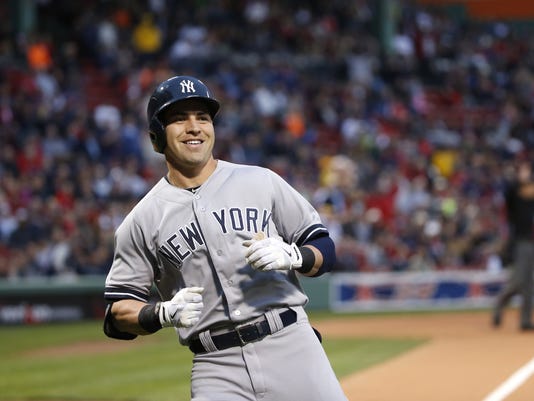
As we enter play on this last day of April, the Yankees first baseman is hitting .283/.397/.538/.935 with eight home runs, 25 RBI, 30 hits in 106 at-bats, and has a 0.8 WAR already. This came after I, Daniel Burch, was very much on-board with trading high on the current MLB Player of the Week. I made mention more than once this offseason that the Yankees should sell high on Voit and bring in another first baseman, and I was wrong.

Where would the Yankees be right now if it were not for Voit getting on base every day for nearly 40 straight games now? Where would the Yankees be if they relied heavily on Greg Bird once again and his ailing lower half in 2019? Where would the Yankees be if it were not for, another point of contention for me this winter, what seems to be Voit’s improved defense over at first base and knack for absolutely clobbering the crap out of the ball to the deepest part of almost every ballpark that he plays in?

Not where they are today.


Here is a better question for you. Where would the Yankees be, and I mean specifically this current crop of players, without Luke Voit’s leadership role that he has taken on and his warm embraces after a victory? You want to talk about leading a young group of guys and having fun while the team is winning? We haven’t seen that on this team, to this degree, since Nick Swisher was with the club back in 2009.

I’m not comparing the two teams, but you know what? Maybe I am comparing the two men. Clubhouse wise. Leadership wise. Personality wise. Yankee wise.

Luke, no one is happier than I am to gladly and fully admit that I was 100% wrong about you as a player. Keep proving me wrong, and I’ll keep appreciating it every step of the way.

photo credit: River Ave Blues

Also, a quick shout out to River Ave Blues on their final day. If it weren’t for publications and groups like you, I would likely not be here today, so I am forever grateful for Mike Axisa and his crew for all their hard work and generosity throughout the years. You will truly be missed.

Wednesday, April 3, 2019

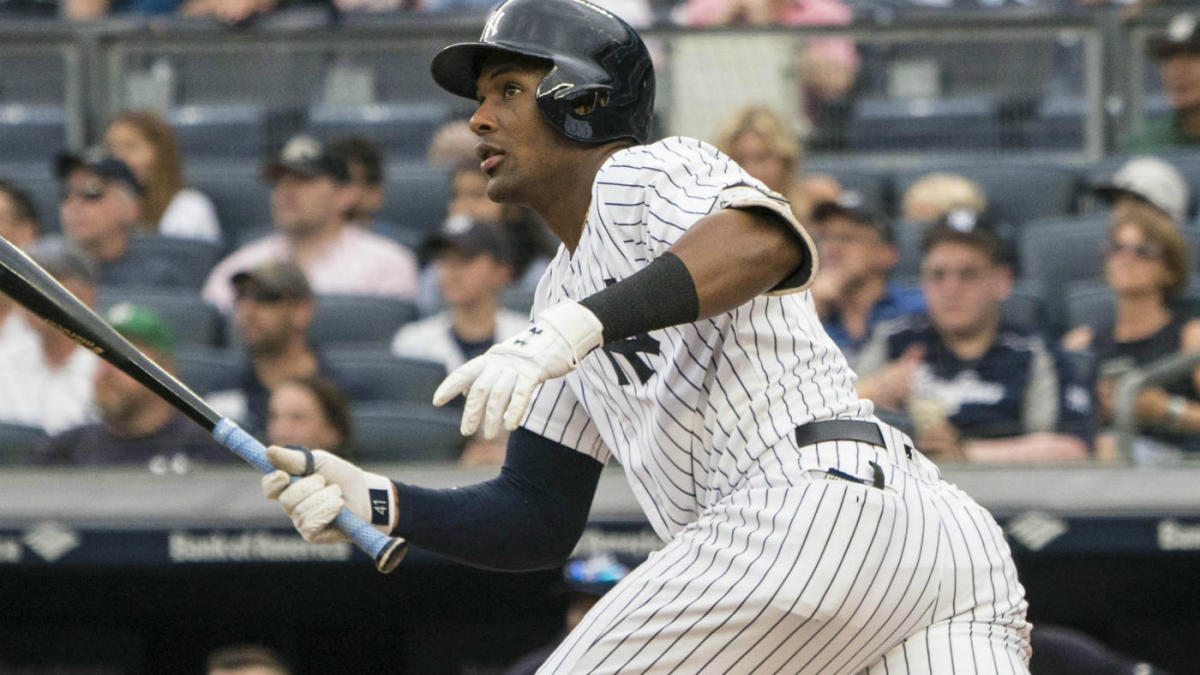
Miguel Andujar, Michael Brantley and a Small History of Players Having and Attempting to Play Through Shoulder Labrum Surgery


The New York Daily News reported today that Miguel Andujar, the third baseman of the New York Yankees, would attempt to play through a “small tear” in his right shoulder labrum that he suffered on a play earlier in the week. There are plenty of mixed emotions and opinions on this, but instead of jumping on one end of the spectrum or another, instead I decided to do some research. Honestly, I had no idea if it was a good idea that Andujar tried to play with the injury or not. I honestly had no idea if this could make the injury much worse, or if it would mean more time off if it did for the promising young Yankees star, so I did some research. I looked at some of the more recent and comparable torn labrum situations across MLB and found one such situation that fits that of Miguel Andujar’s situation more so than any other. But before we jump right into that, let’s take a look at some of the more recent labrum surgeries, their success rates, and how much rehab and “off” time it took to get these players back.

Let me preface this post by saying that I am focusing solely on torn labrums for positional players in this post, and torn labrums in their shoulders only. When I say “the most recent labrum surgery” I mean the most recent that fits the aforementioned criteria. Please do not litter the comments section with the fact that Michael Pineda came back from a labrum surgery or that Alex Rodriguez came back from labrum surgery in both hips, neither are really relevant with the Yankees third baseman.

The first question that came to mind when the news broke, at least in my mind, was if Andujar was able to play through the surgery, how would it affect the Yankees 2020 season? Would the team be without Andujar for a long stretch in 2020 as well? And would that be worth it, given the Yankees “window” with this team? My research brought me to San Francisco and the most recent torn labrum surgery that I could find aside from Andujar’s


Steven Duggar of the San Francisco Giants announced on August 31, 2018 that he would have to undergo surgery on his torn labrum in his left shoulder. Duggar had successful labrum surgery during the month of September last year and was back for spring training and Opening Day. Duggar’s production did not seem to slip after the surgery, which was evident when he was named the Giants starting center fielder here in 2019 (well, until the team acquired Kevin Pillar, but that had nothing to do with his rehab from shoulder surgery in my opinion).

Does that extra month that Duggar had help him in his rehab? I was unsure, so I went and looked for an example of a player that waited until the regular season was over to get the surgery and I ran across the story of outfielder Matt Kemp.


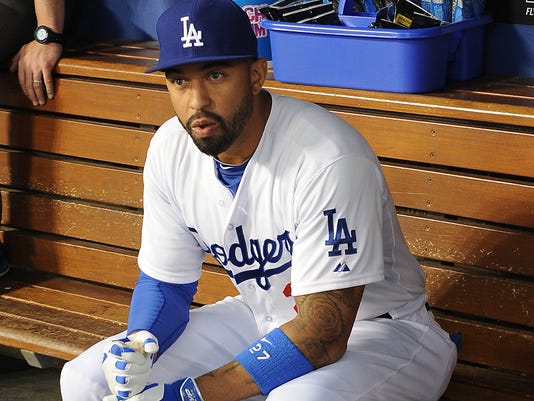
Matt Kemp waited until the offseason after the 2012 season before having his torn labrum surgery and was back on Opening Day in 2013. Granted, his spring training was cut a little short and, granted again, the start to his 2013 campaign left much to be desired, but whether that was because of the surgery or not, while assumed, cannot be confirmed with 100% certainty. Then again, every shoulder is different. Just because Kemp struggled after coming back from the surgery it doesn’t mean that Andujar will. The point of it all is to say that conceivably the Yankees could wait until the end of the regular season to have the surgery and still have Andujar back on Opening Day, or very shortly after, if all goes according to plan.

Here are Kemp's before and after stats from the torn labrum surgery for your reference: 

Standard Batting
Year Age Tm G PA R H 2B 3B HR RBI BB SO BA OBP SLG OPS OPS+
201227LAD10644974122222236940103.303.367.538.906147
201328LAD7329035711506332276.270.328.395.723104
201429LAD15059977155383258952145.287.346.506.852140
My next question was whether or not Andujar could even play through such an injury. In my research, I learned that not many players had even attempted to play through it, nor did I find many examples of a player successfully playing through the injury. Luckily enough, I did find at least one example of both instances, although there are a few more of each.

Devin Mesoraco, at that time a member of the Cincinnati Reds, at least considered playing through his torn labrum in his left shoulder in 2016. Ultimately, Mesoraco was limited to just 16 games that season and opted for the surgery, but the initial report on MLB Trade Rumors on May 2, 2016 stated that Devin at least considered trying to play through the injury. For what it’s worth, Mesoraco is right-handed and the labrum tear was in his left shoulder. While that did not hinder him much in the throwing department, through the research I am gathering it DOES affect hitters more in their lead shoulder (for a right-handed batter it would be their left shoulder) than their back shoulder, the right shoulder on a right-handed hitter like Miguel Andujar.


In our research of an instance where a player did play through a torn labrum, we go to J.J. Hardy of the Baltimore Orioles in 2015. On October 1, 2015 it was announced that Hardy, who opened the season on the disabled list with a “left shoulder sprain” at the time, had been knowingly playing through the year on a torn labrum in his left shoulder. Hardy is a right-handed throwing and batting shortstop, FYI, so it was not on his throwing shoulder, but it was on his lead shoulder while at the plate. Hardy’s final stat line in 2015 with the torn labrum can be seen below. I put his 2014 season, 2016 season, and his career numbers as well just for your reference.

Standard Batting
Year Age G PA AB R H 2B 3B HR RBI BB SO BA OBP SLG OPS OPS+
2014311415695295614228095229104.268.309.372.68290
20153211443741145901408372088.219.253.311.56454
201633115438405431092909482668.269.309.407.71690
162 162 16265560275154301207143100.256.305.408.71490
FYI, through my research I have read that it is much harder to play through a torn labrum on your lead shoulder while at the plate, which means your left shoulder if you are a right-handed batter and vice versa.


I think the most compelling case, and maybe the closest case that matches that of Andujar, is the torn labrum that Cleveland Indians outfielder Michael Brantley suffered in 2015. Brantley, a left-handed hitting and throwing outfielder currently in the Houston Astros organization, was diagnosed with the same “small” tear of his right shoulder labrum in 2015 after attempting to rob then Twins center fielder Aaron Hicks of a triple in a September 22nd game. Brantley would take his next plate appearance after injuring the shoulder but would be removed following the inning. Brantley would appear in two more games that season before the Indians season ended without a trip to the postseason. Initially, both Brantley and the club thought that they could avoid the surgery following the season, but the discomfort in his shoulder lingered for two weeks into his rehabilitation program, prompting the surgical procedure. Brantley was told that he could not pick up a bat for the four months after the surgery. Brantley was also told that he could not begin getting rehab games for at least another month after that, leaving him out for at least six months after the surgery.

Here are Brantley's before and after stats from the surgery. I included Brantley's 2017 stats as well because he was limited to just 11 games in 2016. Brantley had other shoulder issues as well as biceps tendinitis that limited his season that required a secondary shoulder surgery that also cut into his 2017 season as well:

Standard Batting
Year Age Tm G PA R H 2B 3B HR RBI BB SO BA OBP SLG OPS OPS+
201528CLE1375966816445015846051.310.379.480.859129
201629CLE114359200736.231.279.282.56148
201730CLE90375471012019523150.299.357.444.801108
So, how does it compare? Both tears are considered to be “small” and both tears are small enough that the team and the player thought that they could play through the pain. Brantley ultimately couldn’t as pain continued to linger in the shoulder, while Andujar is saying that the shoulder still feels healthy and strong. If pain persists, obviously Andujar will shut it down and face the same time period as Brantley did before the 2016 season, but if he doesn’t experience that same pain are the Yankees essentially robbing Peter of time in 2019 to pay Paul by Andujar missing more time in 2020 because the surgery will need to be completed eventually anyway?


The 2019 season ends on September 29, 2019. If the Yankees do not make the postseason that gives Andujar four months of surgery and rehab (October – January) and a return in February, or whenever spring training begins. If the Yankees make the postseason as a Wild Card you can push that back about a week and get the same result. But if the Yankees make a deep postseason run that stretched until basically the end of October (Game 7 of the World Series would be projected to be played on October 22, 2019) then the Yankees may have a bit of a problem. If the World Series ends somewhere around the last week in October, you have to expect Andujar to not get the surgery until at least the beginning of November. Four months of rehab, November through February, and then another month of rehab games, puts Andujar’s readiness into March, and that’s if everything goes exactly according to plan.

Would the Yankees be better off with Andujar even missing the first month of the 2020 season if it means they have a chance at the World Series here in 2019? The more I research, and the more I think about it, the more I am inclined to say yes. It’s really, for lack of a better term, a no-lose situation here for both Andujar and the Yankees. Andujar needs the surgery regardless. If Andujar attempts to play through it and can’t, he gets the surgery early and is 100% ready for the 2020 season. It’s a huge blow, but the window for this Yankees team stretches far beyond just the 2019 season in my opinion. If he plays through it and does more damage, he is going to need the surgery regardless and can clean it up whenever it occurs, or after the season. A labrum surgery is a labrum surgery. A small tear and a larger tear require the same surgery and the same rehab time, give or take very little. It’s still a very serious and intrusive surgery, so I’m not saying that a smaller tear and a larger tear are exactly the same, but I am saying that with either one it’s likely a five-to-six-month process regardless before being game ready.


I won’t sit here and say I am 100% on-board with Andujar trying to play through this injury, but I can’t say that I am 100% against him trying to play through it either. History suggests that he can and that the Yankees, nor Andujar, would be any worse for the wear if he was to attempt to play through the injury, but I’d be lying if it still didn’t scare me just a bit.

Wednesday, March 6, 2019

Should the Yankees Sign Gio Gonzalez?


The New York Yankees lost Luis Severino for at least a few weeks to open the season after the right-hander was scratched from his spring debut with shoulder discomfort. The diagnosis was inflammation in his right rotator cuff and the cure, the Yankees hope anyway, is two weeks of rest and some anti-inflammatories. Immediately following the news, the focus shifted to whether or not the Yankees should add another pitcher, namely either Dallas Keuchel or Gio Gonzalez. While I think many are well-versed in what Keuchel brings to the table already, I think most don’t truly know what the team would be acquiring if they were to go out and sign Gonzalez on a one-year (presumably) deal. How would Gio pitch in the American League after splitting time with Washington and Milwaukee in 2018? The stats suggest that he may not fare so well for the Bronx Bombers…

First, let’s look at Gio’s career stats inside of Yankee Stadium. Gio has pitched three games inside Yankee Stadium III, all three of them starts spanning 17.2 innings pitched. Combined, Gio has allowed 13 hits and nine runs to the Yankees, all of them earned, on one home run with nine walks. Gio did strike out 16 batters for almost a batter struck out per innings pitched, but a WHIP of 1.245 and a 4.58 ERA leaves much to be desires. Sure, the sample size is small, but the sample size expands a bit when you look at what he has done in other key American League ballparks.


I Split W L ERA G IP H R ER HR BB SO WHIP SO9
LAA-Angel Stad324.05633.1291615313301.2608.1
DET-Comerica Pk0232.4025.01619185343.8007.2
CHW-US Cellular033.98320.11610919231.23010.2
HOU-MinuteMaidPk103.60215.0146604161.2009.6
BOS-Fenway Pk305.08528.1281716415291.5189.2
MIN-Metrodome0121.0013.08771353.66715.0
CLE-Progressive401.13640.02865216391.1008.8
OAK-O.co Colis21153.7347277.1244125115311382561.3778.3
BAL-Camden Yards233.15745.2471816517311.4016.1
KCR-KauffmanStad326.14629.1342120616171.7055.2
SEA-Safeco Fld223.48844.0411917127521.54510.6
TOR-Rogers Ctr135.70423.2201515311191.3107.2
MIN-Target Field111.50212.074206111.0838.3
TEX-Rangers Bpk124.29521.026141057181.5717.7
TBR-TropicanaFld0216.0049.0181616113113.44411.0
NYY-Yankee Stad3114.58317.2139919161.2458.2

Now, you must remember that Gio did much of his damage in the American League as a much younger pitcher with the Oakland Athletics. Whether that works for him or against him at this point in his career remains to be seen, but it is worth mentioning that Gio’s first four seasons in Oakland resulted in a 38-32 record with a 3.93 ERA, 4.06 FIP, and a 1.410 WHIP. Meanwhile, in the National League, Gio posted a total of 89 wins and 65 losses with a 3.59 ERA, 3.45 FIP and 1.276 WHIP with the Nationals and Brewers. Gio was a much better pitcher in the National League and that should scare you if you are a fan of the New York Yankees signing him.


I’m not saying that Gio would get lit up in the Bronx, although he may, but I am not saying that he would be that big of an upgrade either. Remember, Gio has missed all of spring training up to date and that’s not nothing. At this point would Gio, at least until Severino returns anyway, be that much better than what the Yankees have in Jonathan Loaisiga and Domingo German? Honestly, I think not. If Severino were having a much more serious injury that we could pinpoint RIGHT NOW, like a Tommy John surgery for instance, then the argument could be made that Gio would be better over the course of a season than what the Yankees already have, but right now we just can’t do that. I wouldn’t feel comfortable even suggesting that.

In closing, stick with what we have and ride the wave. If the Severino shoulder injury becomes more serious, then you react, but right now I feel like it would be foolish to go out and get a guy like Gio, Keuchel, or anyone outside of the organization for what could amount to just a couple missed starts. Maybe I’m wrong, but I don’t think that I am.

What say you?

All stats courtesy of Baseball Reference

Tuesday, February 26, 2019

Meet the 2019 Yankees: Jacoby Ellsbury


Did I just save the best for last, or was the information harder to come by because no one has actually seen Jacoby Ellsbury on a baseball diamond in what feels like two-or-three years? You decide, I am just here to make the formal introductions. Jacoby Ellsbury everyone, in all of his glory.

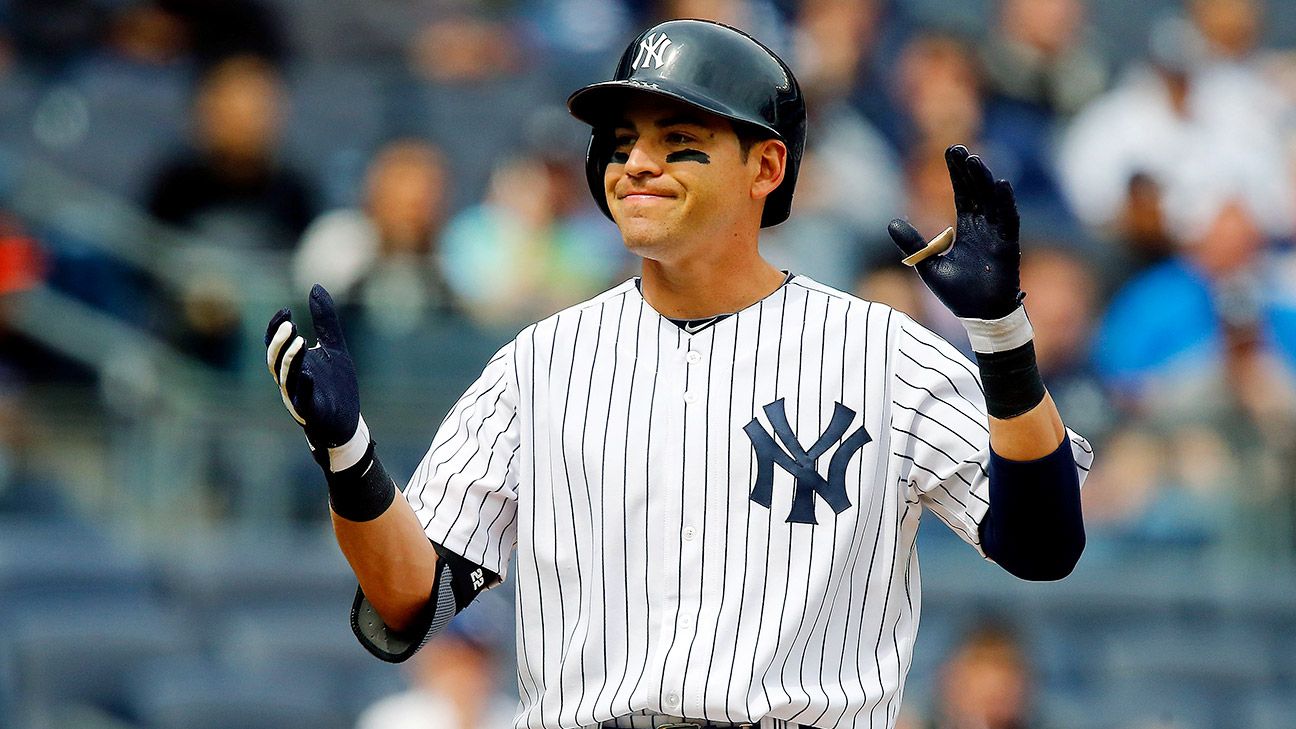
Jacoby Ellsbury, 35-years old, is a center fielder in the New York Yankees organization. Ellsbury, 6’1” and 195 lbs., is a left-handed hitting and throwing outfielder and leadoff hitter, when he is on the field. Injuries have hampered much of his contract with the Yankees that runs through the 2020 season with a team option for the 2021 season. Ellsbury has the uppercut swing, speed, and defense to do well with the New York Yankees, especially inside Yankee Stadium, but his inability to stay healthy has left a bad taste in the mouths of many Yankees fans around the Yankee Universe.


Jacoby McCabe Ellsbury was born on September 11, 1983 in Madras, Oregon where he attended Madras High School. While at the school, Ellsbury lettered in five sports including baseball, basketball and football. Ellsbury was drafted by the Tampa Bay Devil Rays in the 23rd round of the 2002 MLB First Year Players Draft, but ultimately decided to head to Oregon State University to continue his amateur baseball career. After three years at Oregon State, Ellsbury was drafted by the Boston Red Sox in the first round, 23rd overall, of the 2005 MLB Draft.

Ellsbury did not spend long in the Red Sox minor league system, making his professional debut in July of 2015, and making the big-league club by June 30, 2007, replacing an injured Coco Crisp. Ellsbury was up and down for the Red Sox throughout the 2007 season but made his mark late in the season and into the playoffs, leading the Red Sox to a World Series championship. Ellsbury was on the Red Sox Opening Day roster in 2008 and never looked back, thus becoming a regular for the Red Sox in center field and at the top of the Boston lineup. Ellsbury remained an integral part of the team in center field until the 2010 season when he was bumped to left field after the team acquired Mike Cameron off the free agent market. Ellsbury would undergo many ups-and-downs and many injuries throughout his tenure with Boston but would win two World Series with the club including the 2013 season, the final year before he hit free agency.


In the winter before the 2014 season the New York Yankees signed Ellsbury to a seven-year deal worth $153 million including an option year for an eighth season that would bring the deal to $169 million. Ellsbury had a decent first season in the Bronx batting .271 with 16 home runs and 39 stolen bases in 149 games, but the 2015 season the injury bug crept back into Ellsbury’s career. Ellsbury missed nearly two months with a sprained knee in 2015 and did not start the 2015 American League Wild Card Game for the Yankees against the Houston Astros.

The 2016 season was the season of catcher’s interference for Ellsbury and the Yankees. Ellsbury played in 148 games in 2016 and compiled 12 catcher’s interference calls, breaking the record previously held by Roberto Kelly in a single-season. Ellsbury would set the career mark for catcher’s interference calls in 2017 with his 30th, passing Pete Rose, but would ultimately lose his starting center field job to Aaron Hicks after another set of injuries derailed his season. Ellsbury would miss the entire 2018 season due to injuries and will likely begin the 2019 season on the injured list as well.


Ellsbury is an enrolled member of the Colorado ricer Indian Tribes. Ellsbury’s mother, Margie Ellsbury, is full-blooded Navajo, while his father, Jim, is of English and German descent. Ellsbury is the first Native American of Navajo descent to reach the major leagues. Now, the only thing that’s left is for Ellsbury is to bounce back healthy in 2019 and lead the team to a World Series championship as the first ever Navajo Native American to win a World Series in the Bronx. Make it happen.