Showing posts with label Hot Stove. Show all posts

Tuesday, December 29, 2020

Trevor Story > DJ LeMahieu in Pinstripes? Maybe - My Offseason Plan


I haven’t added anything to the blog lately, so let’s come out with the smoke. If the Yankees were to acquire Trevor Story from the Colorado Rockies in a trade this off-season he will be better in pinstripes than DJ LeMahieu was. There, I said it.


Now that we got that out of the way, let’s analyze. The New York Yankees acquired DJ off the free agent market two seasons ago with the hopes of the right-hander filling in as a super utility player for the Yankees in the infield. No one, except me, expected LeMahieu to break out in the way he did in 2019, and again in 2020, and most of the people who saw this headline probably never even made it this far into the article. I’m not worried about if people agree with me or not, most didn’t when I said that Kyle Higashioka not only should, but would, become Gerrit Cole’s personal catcher and I was okay with that too. It’s not even about being right, it’s about what is best for the team. Adding Trevor Story makes this team better, with or without DJ. Keep reading, please.
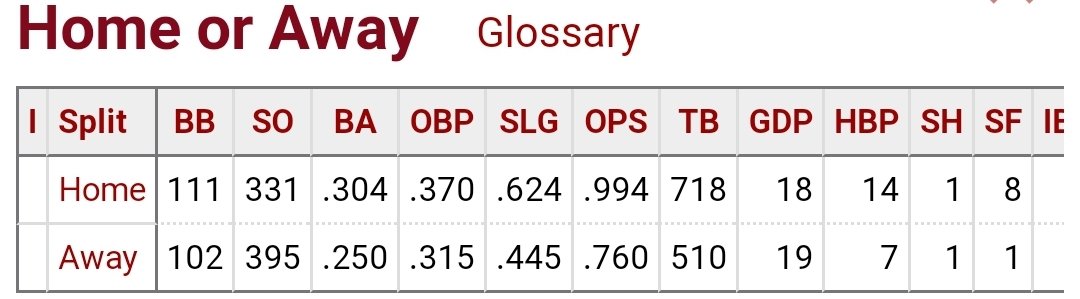


Like I said two years ago with LeMahieu, Story would benefit immensely from making the shift from the NL West to the AL East Division. Now, before we get too upset again, I will admit that Story most definitely benefitted from playing inside Coors Field, like most who have ever played there, but Coors Field did not make Story the exciting player that he is today. His splits will tell you that he does better as a home player versus what he does as a member of the road team, but what it doesn’t tell you is that there are a lot of factors that just don’t get included in those splits posted above. What those splits don’t tell you is how Story potentially was hurt, production wise, by playing inside parks like Petco Park in San Diego, AT&T Park in San Francisco, etc. It also doesn’t show you how Story would actually benefit from not playing 10-15 times in each of those stadiums, while shifting those away games to more hitter friendly environments like Boston’s Fenway Park, Baltimore’s Oriole Park in Camden Yards, the Rogers Centre (or the Stadium up in Buffalo, NY) in Toronto, and Tropicana Field down in Tampa.
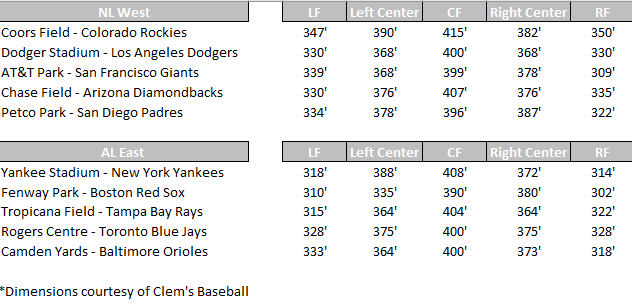


Dimensions, level of talent on each side (imagine having to play the San Diego Padres and Los Angeles Dodgers 30 times a season versus playing the Red Sox, Orioles, Blue Jays and Rays), and the team around him are all kept out of the splits that we see on Baseball Reference.
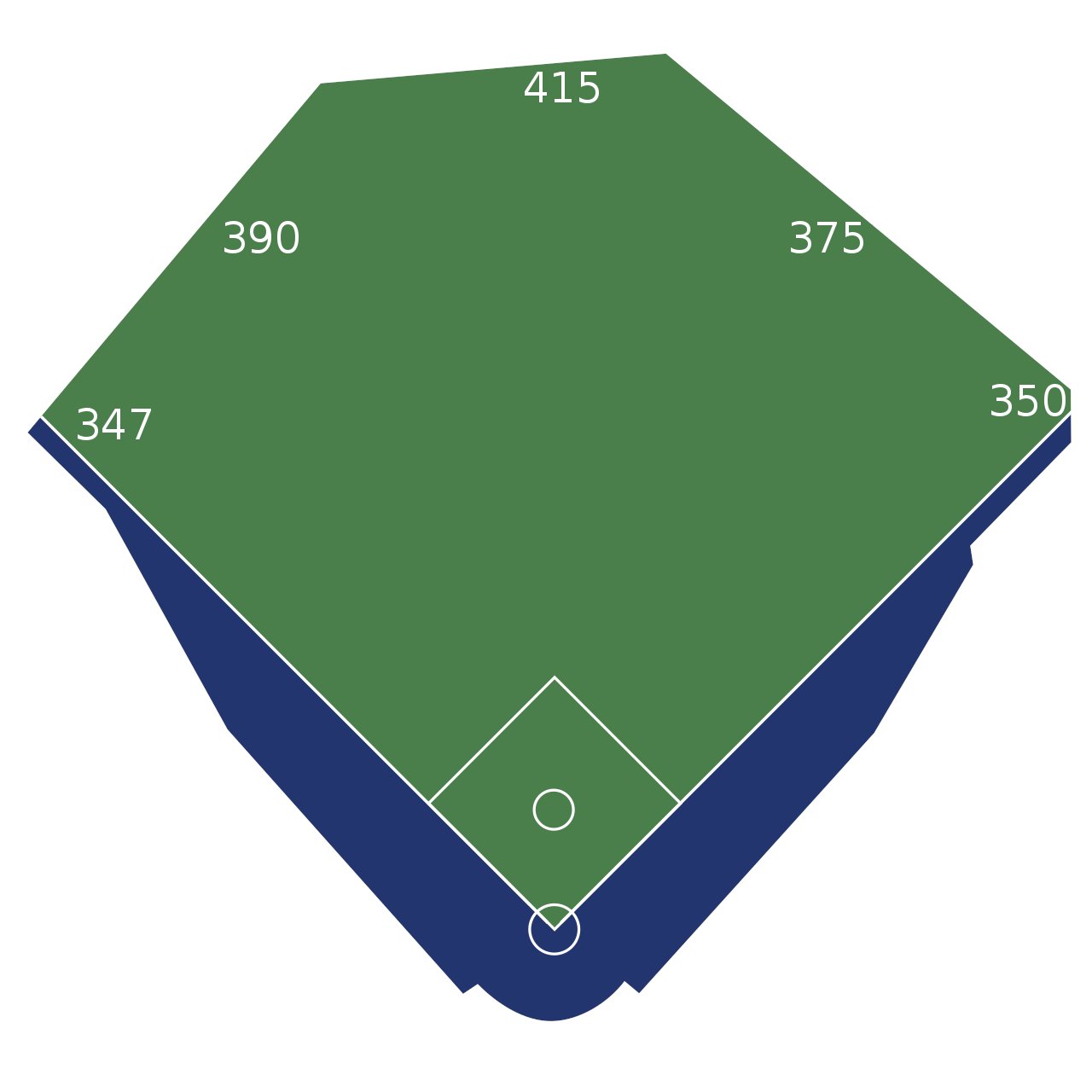
 

Coors Field dimensions


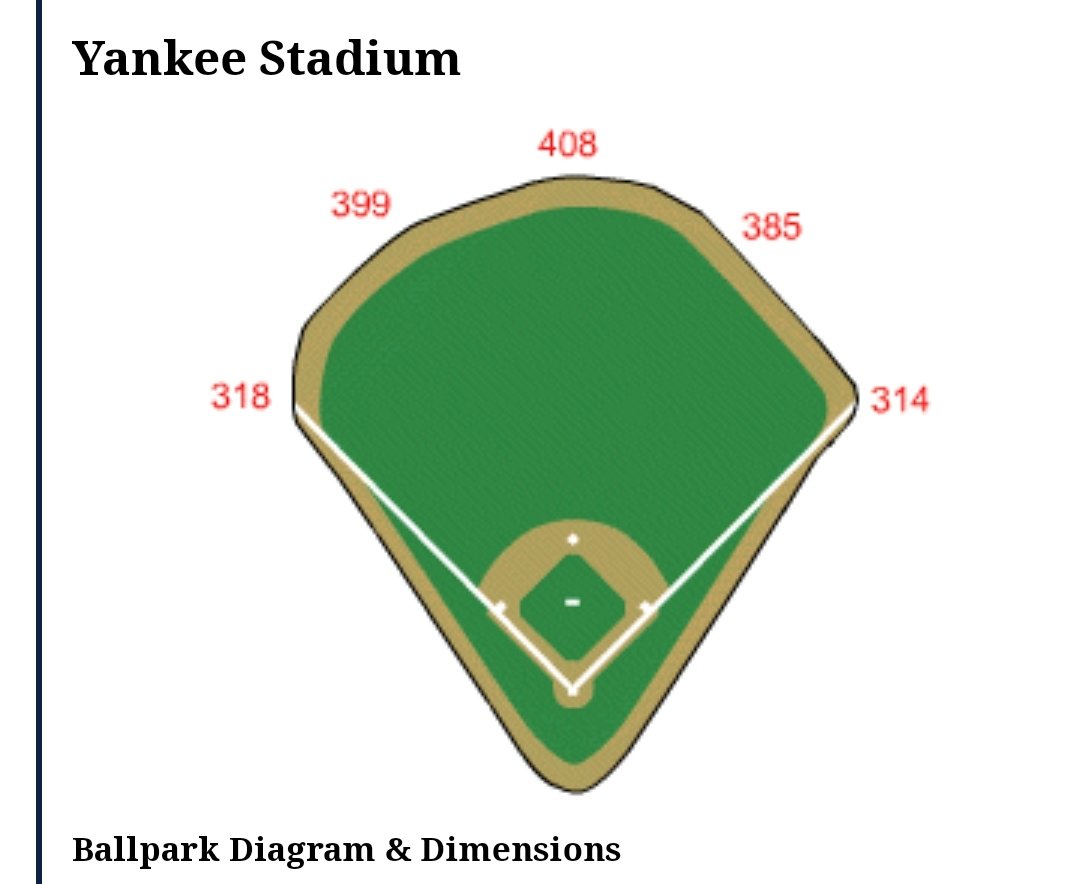
Instead of focusing too much on what Story could potentially do as a road player for the Yankees inside these stadiums, I prefer to focus on what he could do inside Yankee Stadium. If Story craps the bed in the Bronx, it probably doesn’t matter as much what he does against everyone else. Agree? While it is hard to predict what he will do, his spray charts mixed with the overall dimensions of Coors Field vs. Yankee Stadium make it a little easier.
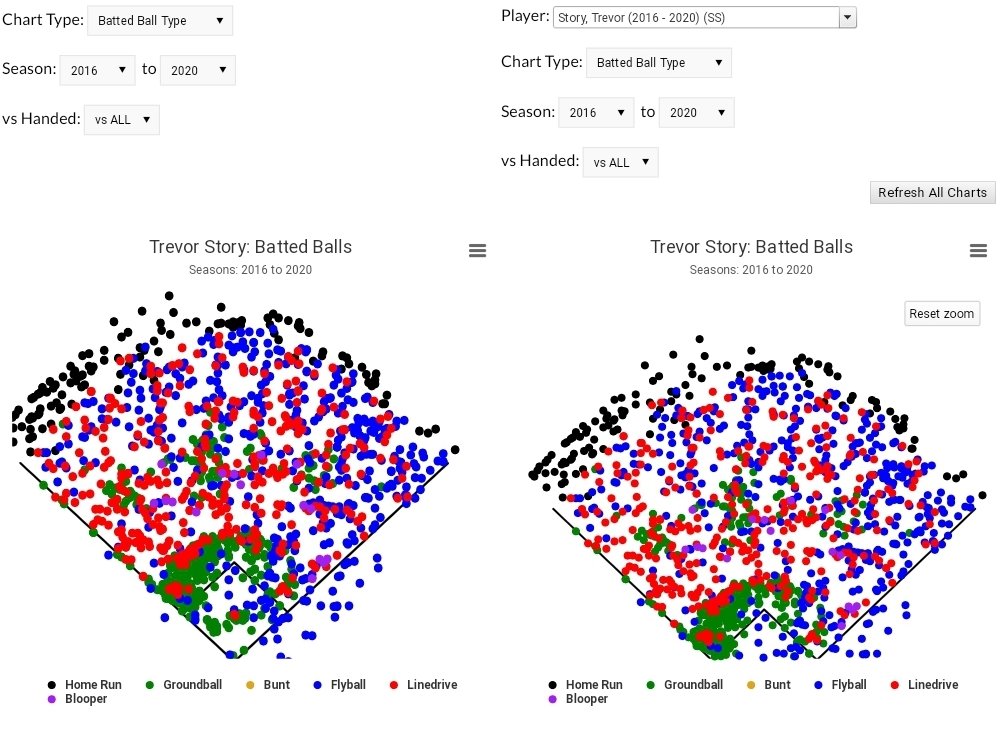


Story, like DJ, sprays the ball all over the field for average and for power. Story, like DJ, would wreak havoc on the short porch in right field given his tendencies to go the other way for power. Story, like DJ, was actually hurt by this while playing in a much more spacious Coors Field. The ball carries more in Coors Field than possibly anywhere else, but it really carries down that right field line in the Bronx as well. Story, like DJ, will benefit much more in the Bronx than he did in Colorado because a lot of those line outs and fly outs will turn into doubles, home runs and scoring opportunities in the Bronx (in a perfect world). Story would give the Yankees another “professional hitter” on the club, although his strikeout numbers are his biggest flaw in my opinion, while also giving the team something they need possibly more so than hitting, and that is defense. Specifically, defense at the shortstop position.


Acquiring Story allows the Yankees to move Gleyber Torres back to the position he is better suited for defensively, the second base position, while allowing Story to slide into the shortstop position. The infield defense is instantly better, but does this mean that this would leave DJ on the outside looking in for the 2021 season? Not necessarily, this is where the “Get Greedy” part comes out of me. In my plan, you acquire Story to allow him to play short and you move Gleyber back to second, but you also sign DJ with the intention of being an “every day” first baseman. Yes, he would move around and wouldn’t be containted to only first base, but that would be his position on Opening Day. What does that mean for Luke Voit? Well, listen, I love Voit as much as the next guy, but if the Yankees are looking to trade away from their core in order to keep costs down and fill the gaps needed on the field, he makes the most sense to move on from. Why? Because he has tremendous value right now, his defense at first base is atrocious, and if the Yankees have to choose one strength to trade from it should be from the power department and not from the average-first/professional-type hitters. If the Yankees trade Voit they could still hit 270-280 home runs this season, maybe more with Story if he has a big season, but the team would be more balanced, better defensively, and better overall.


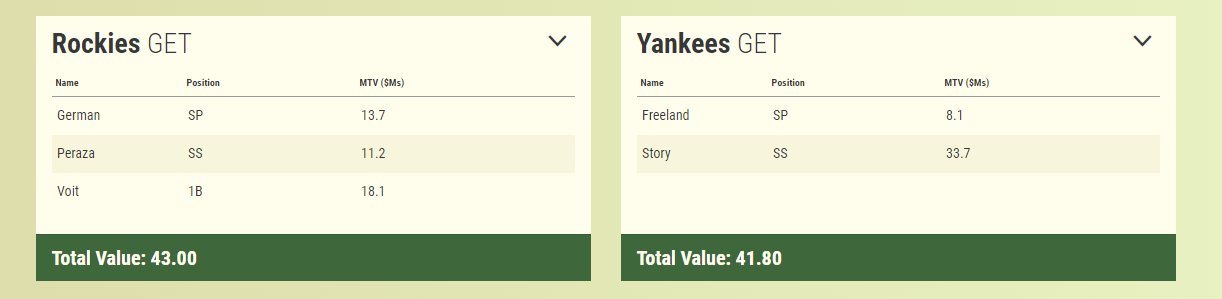
Having an infield defense of Gio Urshela, Story, Torres and DJ behind a pitcher like Luis Castillo or equivalent (Voit included in the trade to keep the prospect cost down) is much better than having an infield defense of Gio, Gleyber, DJ and Voit behind “#2 pitcher” Domingo German, Jordan Montgomery, or whatever dumpster fire pitcher that Yankees GM Brian Cashman tries to sell us on here in about or so. The Yankees could also try and entice the Rockies to include Kyle Freeland (or less likely German Marquez) in the deal by including Louis Vinwood Voit III.


EDIT: Here is a mock trade I threw together rather quickly. While this isn't the trade I necessarily see happening, something similar could go down if this were to come to fruition. 


Standard Batting - Trevor Story
Year Age Tm G PA R H 2B 3B HR RBI SB CS BB SO BA OBP SLG OPS OPS+
201926COL145656111173385358523858174.294.363.554.917119
202027COL59259416813411281532463.289.355.519.874118
162 162 162 1626831011713963610121657195.277.343.535.877114

Standard Batting - DJ LeMahieu
Year Age Tm Lg G PA R H 2B 3B HR RBI SB CS BB SO BA OBP SLG OPS OPS+
201829COLNL128581901473221562653782.276.321.428.74988
162 162 162 162 1626589218229512671264897.305.357.430.787102

Now, since this post has basically turned into a Story vs. DJ post, which was not intended since I planned on bringing back DJ with or without this potential trade, let’s take a look at DJ’s final season in Colorado vs. Story’s 2019 season with the Rockies (we are leaving 2020 out due to sample size for Story). As you can see, Story outplayed DJ in many key categories during this comparison. While you can’t bank on lightning striking twice in the same spot with former Rockies coming over to the Yankees, you can predict it a little better when you know what type of player each player really is. Story, like DJ, uses the entire field and hits for average while taking an ample number of walks. Story will strike out too much and the Yankees faithful will hate that, but that’s where the comparison ends. DJ is a lead-off type hitter that loves to jump on a first pitch fastball. Story does his best work if he see’s a pitch or two first. Story would hit towards the middle of most lineups, but probably around 6th here in the Bronx. He should hit second and Aaron Judge should hit third, in my opinion, but manager Aaron Boone (or is it Cashman here too?) seems obsessed with keeping Judge in the two hole. Judge has a higher career OBP than Story (Judge’s .390 OBP vs. Story’s .343), but again we are stuck in a place where one stat doesn’t tell the whole story. Judge has seen the likes of Aaron Hicks and Brett Gardner hitting behind him in the 3rd slot just for the sake of having a lefty up there, and while that’s not the sole reason for his OBP advantage, it certainly helps. Why pitch to Judge with Brett Gardner on deck? Especially with RISP. You don’t. In fact, you should never. Judge can change the game with one swing of the bat, Gardner and Hicks generally don’t do that.


My Yankees lineup, not the Yankees lineup that I think would be put out every day, would be this if the team were to acquire Story, re-sign DJ, and trade Voit for pitching:


1B – DJ LeMahieu

SS – Trevor Story

RF – Aaron Judge

DH – Giancarlo Stanton

CF – Aaron Hicks (for the sake of a lefty)

2B – Gleyber Torres

LF – Clint Frazier

3B- Gio Urshela

C – Gary Sanchez


Let me be frank, I don’t think this is what the Yankees are going to do. This is merely what I would do as the GM of the New York Yankees. I am not sure what the Rockies would need or want to include Story, or Story plus Freeland/Marquez, but with the Padres and Dodgers stranglehold on the division for a while I would lean towards the team being ready for a “total rebuild.” I say that with parenthesis because I find it unlikely that the team will be able to move Arenado in this current economic climate, but at the same time I also don’t think the likes of Frazier or other top talent and MLB-ready talent would need to be included beyond Voit. If the Rockies are interested in what many Yankees fans perceive as fringe players on the roster, Miguel Andujar, Mike Ford, Mike Tauchman and Tyler Wade immediately come to mind, then naturally that deal could change, but I am thinking of everyday players only when I say that.


Adding a defensive-minded shortstop that can hit over .300 with 20+ home runs and 90+ RBI a season to an already potent lineup seems unfair. Making the defense exponentially better while allowing the Yankees to trade Voit (and not miss much production, because remember Story’s production would somewhat offset what was lost by the exit of Voit) and add the cost-controlled young #2 or even #3 pitcher to match up with Cole… now that’s just being Greedy… and I love being Greedy.


Monday, February 25, 2019

Yankees Sign Hicks to 7-Year Deal Worth $70 Million


The New York Yankees have signed Aaron Hicks to a new seven-year deal worth $70 million that will begin in 2019 and keep the switch-hitter in Yankees pinstripes through his age 35 season. There is also a club option for an 8th season. The deal runs from age 29 until Hicks is 35, 36 if the club option is exercised.

Here is a breakdown of what the deal looks like:

2019 - $6 million salary, plus $2 million signing bonus
2020- $10.5 million
2021 - $10.5 million
2022 - $10.5 million
2023 - $10.5 million
2024 - $9.5 million
2025 - $9.5 million
2026 - $12.5 million club option or $1 million buyout

Hicks does not receive a no-trade clause, but gets $1 million in bonus money if traded

FYI, according to Fangraphs and their "value" stat, Hicks was worth a $26.4 million contract in 2017 and worth a $39 million contract in 2018... and the Yankees just got him for $10 million a season.

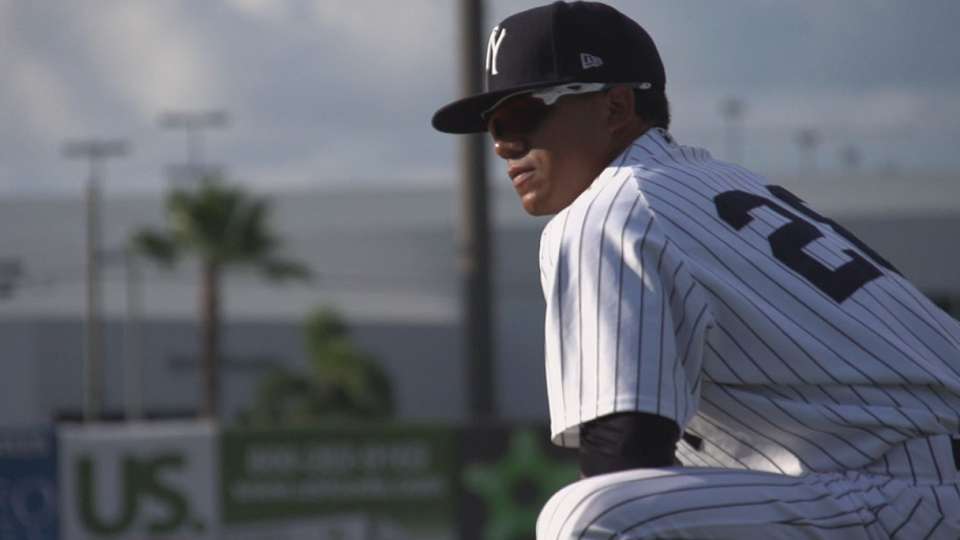
Meet the 2019 Yankees: Thairo Estrada


For whatever reason it feels like Thairo Estrada has been around forever with the New York Yankees. It is hard to believe that Thairo is still just 22-years old, but it’s true. It’s also hard to believe that Thairo survived a gunshot wound in the hip during a robbery attempt in January of 2018, but that’s another story for another blog post. Let’s meet the man that will look to finally crack the Major League roster here in 2019, Mr. Thairo Estrada.

Thairo Estrada, 23-years old with a Happy Belated birthday from us here at TGP, is a right-handed throwing and batting infielder that has experience as a second baseman, shortstop, and third baseman as a professional player. Estrada has a small frame, standing just 5’10” and weighing just 185 lbs., but he will take his walks and hit for average if he’s healthy and right, physically.


Thairo Jose Estrada Villegas was born on February 22, 1996 in Bejuma, Venezuela where he was signed as an international free agent back in August of 2012. Estrada made his professional debut with the club’s Gulf Coast League team in 2013 and spent the whole season there. Estrada returned to the GCL Yankees in 2014 but was quickly promoted to the Staten Island Yankees. Estrada returned to the New York-Penn League and the SI Yankees in 2015, but again earned a promotion to the Charleston Riverdogs and the Tampa Yankees by the time the 2016 season came along.

Estrada was promoted to the Trenton Thunder in 2017 and was an Eastern League All-Star in Double-A, finishing the season with a .301 batting average with six home runs and 48 RBI. Estrada was added to the Yankees 40-man roster following the season.


Estrada was shot in the hip during a robbery attempt before the 2018 season and was limited to just 18 games and 78 at-bats between Triple-A and the Tampa Yankees of A+ ball. Estrada also went to the Arizona Fall League following the 2018 season and played in 19 games there with Glendale. 
Estrada will look for another productive and healthy season in 2019 and will also hope for his ultimate shot at the Major League level. Estrada is ready, make the call.

Sunday, February 24, 2019

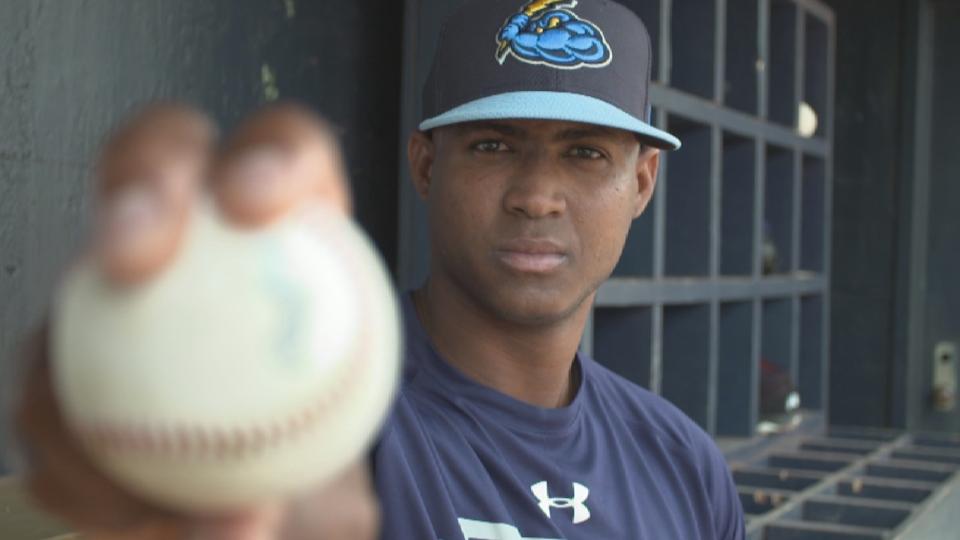
Meet the 2019 Yankees: Domingo Acevedo


I have personally donned this man the next Dellin Betances, and for more than one reason. Both men are really big, intimidating figures on the mound. Both men can throw right at or in excess of 100 MPH. Both men struggle with control, and ultimately for that reason both men may be destined to share the same Yankees bullpen in the future. For now, though, Domingo Acevedo is a starter within the New York Yankees organization, so let’s meet him.

Domingo Acevedo, 24-years old for a few more days, possesses a 96 MPH four-seam fastball, an 87 MPH slider, and an 88 MPH changeup that he mixes in to keep opposing batters off of his heater.  


Domingo Antonio Acevedo was born on March 6, 1994 in Los Almacigos, Dominican Republic where he was signed as an international free agent by the New York Yankees in 2012. Acevedo signed with New York for just $7,500 and began his professional career with the Dominican Summer League Yankees. Acevedo worked his way through the Yankees organization, reaching as high as Double-A and Triple-A in 2017 as well as participating in the 2017 All-Star Futures Game.

Acevedo’s biggest hurdles that he faces is his struggle with command and control, as well as his seemingly inability to stay healthy. In six minor league seasons, Acevedo has made just 92 appearances for the Yankees various minor league affiliates.


Acevedo was called up to the Major Leagues on July 21, 2018 but was optioned back to Double-A in just a few hours, not making an appearance for the big-league club. Will 2019 be the year that Acevedo finally puts it all together for a full, healthy, and productive season? Stay tuned.

Saturday, February 23, 2019

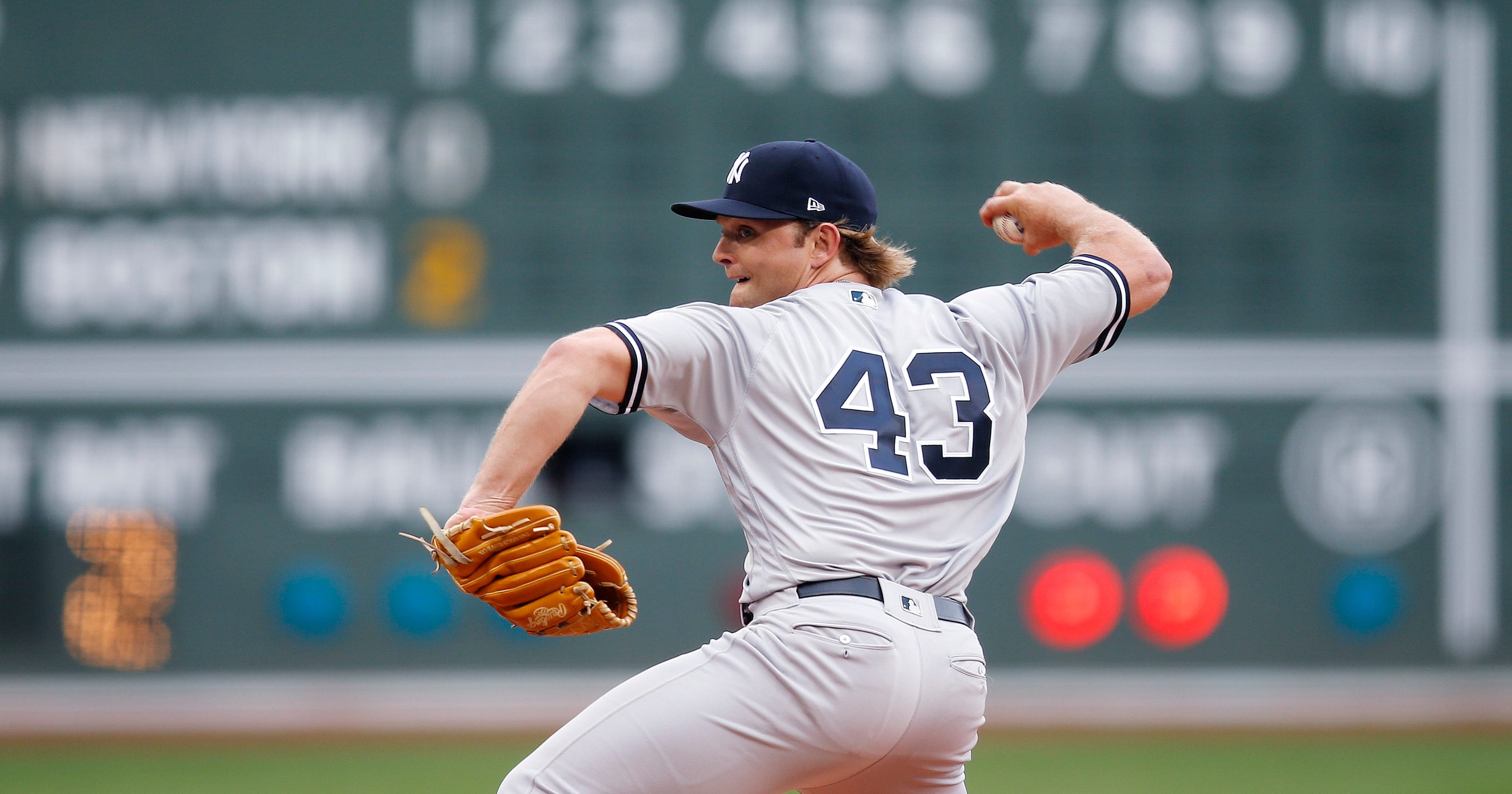
Meet the 2019 Yankees: Chance Adams


One of my favorite Yankees prospects coming through the system was and is Chance Adams. Adams was drafted as a relief pitcher and was converted to the starting role down in the Minor Leagues with varying degrees of success. Chance took off as a starter but fell on hard times at the end of the 2017 season and throughout the 2018 campaign as well. I, personally, am not ready to give up on such a promising arm and I fully expect him to bounce back here in 2019 as a starter for the Yankees. Let’s meet him, Mr. Chance Adams.

Chance Adams, 24-years old, is a right-handed starting pitcher out of the New York Yankees organization. Adams’s repertoire consists of a 93 MPH four-same fastball, a 79 MPH curveball, an 85 MPH slider, and a rarely thrown 85 MPH changeup. Adams’ fastball is considered to be average, with little movement, and is used as a pitch-to-contact pitch rather than to strike out opposing batters. Adams uses his slider to generate groundballs to get the majority of his outs. Adams is 6’1” and weighs in at 220 lbs., unless of course he is sporting that impressive beard that he was seen with during the offseason. That has to add a pound or two, you would think.


Chance Adams, no middle name like myself, was born on August 10, 1994 in Scottsdale, Arizona where he attended Chaparral High School. Adams played college baseball at Yavapai College for two years before transferring to Dallas Baptist University. After one year there, the New York Yankees drafted the right-hander in the fifth round of the 2015 MLB First Year Players Draft. Adams made his professional debut with the Staten Island Yankees and finished his first professional season with the High-A Tampa Yankees.

Adams was converted into a starting pitcher beginning in 2016 and saw immediate results from the conversion. Adams started the 2016 season with a 5-0 record with a 2.65 ERA in 12 games before being promoted to Double-A with the Trenton Thunder. Adams finished the season in Trenton with an 8-1 record and a 2.07 ERA. Adams continued to destroy AA pitching in 2017 and quickly earned a promotion to Triple-A before finishing the season with a combined 15-5 record and a 2.45 ERA in 150.1 innings pitched.


Adams would struggle for a lot of the 2018 season, but he was called up to make his MLB debut against the Boston Red Sox inside Fenway Park on August 4. Now, Adams will look to build on the positives from last season and move forward in his path back towards the big-league level. I’m not ready to give up on you Chance, and I’m sure there’s plenty of fans backing you that feel the exact same way as I do. Good luck to you this season and I look forward to seeing you back in the Bronx at some point here in 2019.

Thursday, February 21, 2019

Meet the 2019 Yankees: Aaron Hicks


A lot of people sleep on the Yankees center fielder and I truly don’t know why. Even as recently as this offseason I have seen trade proposals from fans, by the way… as Mike Axisa of River Avenue Blues says… your trade proposal sucks, involving Hicks and others for pitchers like Madison Bumgarner, etc. Why? Let me ask you a question, we all know that Mike Trout is the best center fielder in the game, but according to WAR, do you know who the second best was? While you Google that and pull up Baseball Reference let’s meet the man with the second highest WAR for all center fielders in the game in 2018, and the man that still gets no respect. Mr. Aaron Hicks, everybody.

Aaron Hicks, 29-years old, is a switch-hitting and right-handed throwing center fielder for the New York Yankees that was acquired from the Minnesota Twins. Hicks, 6’1” and 202 lbs., is entering the final year of arbitration eligibility and will become a free agent at the end of the season if he and the team do not work out an extension before the end of the 2019 World Series. Hicks has a patient approach at the plate and will take his walks when given to him, and personally I see him leading off for the Yankees here in 2019.


Aaron Michael Hicks was born on October 2, 1989 in San Pedro, California. Hicks attended Wilson Classical High School in Long Beach, California where he caught the attention of the Minnesota Twins who drafted him in the first round of the 2008 MLB First Year Players Draft. Hicks, considered a top prospect in all of baseball and the Twins top prospect for much of his Minor League career, spent time in Minnesota’s minor league system until March 24, 2013 when it was announced that he would be the team’s Opening Day center fielder entering the season.

Hicks chose to honor Dave Winfield by choosing #32 for his uniform number. Hicks struggled in his rookie season, batting just .192 before being sent down to Triple-A for the remainder of the season on August 1. Hicks was back in center field on Opening Day 2014 for the Twins, although he struggled once again out of the gate and was once again demoted to the Minor Leagues on June 9. Hicks gave up switch-hitting in 2014 due to the lack of confidence in his ability to hit left-handed, however he went back to switch-hitting less than a month later after being sent down.


Hicks improved in 2015 and finally showed glimpses of what he could be, finishing the season with a .256 average and 11 home runs with 33 RBI in 97 games. The Twins decided to sell high on Hicks and traded him following the 2015 campaign to the New York Yankees for catcher John Ryan Murphy. Hicks regressed a bit in 2016, posting a .217 average with just eight home runs and 31 RBI in 123 games, but his defense and ability to hit left-handed pitching intrigued the Yankees enough to give him the starting center fielder job once again in 2017.

The patience and work with Hicks finally paid off for New York and for Aaron in 2017. By early June, Hicks had already surpassed his entire 2016 totals in home runs (10) and RBI (34) and was among the top ten in the league in both OBP and OPS. Hicks was slowed by an oblique injury in June and again on September 3, finishing the season with a .266 average and 15 home runs with 52 RBI, all career highs. Hicks was again among the best center fielders offensively and defensively in 2018 and finished the season again with career highs in home runs (27), RBI (79) and hits (119).


What does the future hold for Hicks in 2019? Will we see an all new set of career highs? Honestly, I think so, and naturally I hope so, but you will just have to stay tuned to the 2019 Yankees to find out. We are rooting for you A-Aron!!

Monday, February 18, 2019

Meet the 2019 Yankees: Aaron Judge


The 2019 Yankees, much like the 2018 and 2017 versions, will live and die by the towering presence in right field named Aaron Judge. This is my opinion only, but I have a sneaking suspicion that I am not going to be the only person who really thinks so. Judge is a beast with the bat and a stellar defender with a rocket for an arm out in right field, but he is also the heart and soul of the team. As Judge goes, the team goes, so let’s get reacquainted with the man that will tow the line for the New York Yankees all season long here in 2019. Mr. Aaron Judge everybody.

Aaron Judge, 26-years old, is a right-handed hitting and throwing right fielder for the New York Yankees. While in the minor leagues Judge was used as a center fielder and left fielder as well, showing a familiarity with all three outfield positions throughout his MLB and professional career. Judge is going to strike out a lot, but he is also going to hit home runs a lot and drive in runs a lot while hitting around the .280 mark, if history is any indicator of his future.


Aaron James Judge was born on April 26, 1992 in Linden, California where he was adopted the day after he was born by Patty and Wayne Judge. Both of Aaron’s parents were school teachers. Judge attended Lindgren High School where he was a three-sport star. Judge was a pitcher and a first baseman for the baseball team, a wide receiver for the football team, and was a center for the basketball team. Judge excelled at all three sports, but he especially caught the eye of the Notre Dame Fighting Irish and Stanford Cardinals in college football, both wanted Judge to play tight end, as well as the Oakland Athletics and Fresno State University. The Oakland Athletics selected Judge in the 31st round of the 2010 MLB First Year Players Draft, but instead Judge opted to go to college and play baseball for the Fresno State Bulldogs baseball team. Judge slugged his way to a WAC tournament title and College Baseball Home Run Derby, among other accolades, through the 2013 season before the New York Yankees drafted the right fielder in the first round of the 2013 MLB Draft, 32nd overall. Judge signed with the Yankees for $1.8 million and began his professional career with the club in 2014.

By 2015, the Yankees invited Judge to the spring training camp and also had their right fielder at the highest minor league level of Triple-A. Judge represented the Yankees in the 2015 All-Star Futures Game, but the team kept him out of their batch of September call ups due to a roster crunch. Judge was chosen as a 2016 Triple-A All Star but opted not to play in the game after spraining his knee earlier in the season. Judge, instead, got healthy and took the time off, hoping for a call up to the Major League level, a call that would come on August 13, 2016. Judge made his MLB debut against the Tampa Bay Rays that day and hit a home run in his first at-bat, just one at-bat after Tyler Austin, also making his MLB debut, also hit a home run in his first MLB at-bat. This was the first time a pair of teammates hit home runs in their first career at-bats in the same game. Judge was named the Yankees Opening Day starting right fielder for the 2017 season, and the beginning of a special season took off almost immediately.


The Yankees debuted a cheering section in the right field seats in 2017 called “The Judge’s Chambers” on May 22 after Judge won AL Rookie of the Month in April. Judge won the award again during the month of May en route to being voted as the starting right fielder for the American League in the 2017 All-Star Game. Judge broke the Yankees rookie record for most home runs in a season when he hit his 30th home run, passing Joe DiMaggio and became just the second rookie ever, the first being Mark McGwire, to have 30 home runs before the All-Star break. Judge won the 2017 Home Run Derby and even passed McGwire for the most home runs by a rookie in a single season when he hit his 49th and 50th home runs on September 25. Judge led the Yankees to the AL Wild Card, an eventual win over the Minnesota Twins, and within one game of the 2017 World Series before ultimately falling to the Houston Astros in the seventh game of the ALCS. Judge was unanimously voted as the American League Rookie of the Year in 2017 and also finished 2nd in the AL MVP Award vote behind Houston’s Jose Altuve.


Judge was back to prove that there wouldn’t be a sophomore slump, and he did just that in 2018 for the New York Yankees. Judge was once again a starting outfielder in the 2018 MLB All-Star Game, although the Yankees right fielder chose to skip the Home Run Derby this season. Judge wondered if a shoulder injury that required surgery the previous offseason was caused by participating in the 2017 Derby but skipping the event would not keep Judge off the disabled list in 2018. Judge was struck on the wrist by Kansas City Royals starter Jakob Junis, causing Judge to miss two months with the injury. Judge led the Yankees past the Oakland Athletics in the 2018 AL Wild Card Game, but the Yankees fell just short in the ALDS against the eventual World Series champion Boston Red Sox, ending their season prematurely.


Here are a few of the New York Yankees and general MLB records that Judge already holds in his young career, shout out to Wikipedia for these:

New York Yankees franchise records[edit]


  • Most home runs in a season hit at home: 33 (Babe Ruth held the record with 32).
  • Most home runs in a season by a rookie: 52 (Joe DiMaggio held the record with 29)[95]
  • First right-handed hitter in Yankees history with at least 100 RBIs, 100 runs scored and 100 walks in a single season
  • Fifth player in franchise history to start an All-Star Game in the first two seasons. (Following Babe RuthLou GehrigJoe DiMaggio, and Lefty Gomez.
  • Most home runs (4) in the first seven home playoff games, tying Reggie Jackson (1977–78).

MLB records[edit]

  • Most home runs by a rookie, 52 (Mark McGwire held record with 49)[96]
  • Measured exit velocity of 121.1 miles per hour (194.9 km/h), again setting a new record for the hardest ever measured by Statcast. (June 10, 2017)[97]
  • Holds the MLB record for striking out in 37 consecutive games. (2017)[98]
  • Holds the MLB record for most strikeouts by a rookie with 208.
  • Holds the MLB record for most walks by a rookie with 127.
  • First rookie in MLB history with at least 45 home runs, 100 RBIs and 100 runs scored.[99]
  • Most golden sombreros in postseason play since 1903.[100]
  • Fastest to reach 60 home runs (197 games)[101]


Will Judge add any this year in 2019? I surely think so, but you will just have to stay tuned to find out. All Rise, because here comes the Judge.

Meet the 2019 Yankees: Troy Tulowitzki


The New York Yankees signed one of the best shortstops to play the game during my lifetime, but the problem is the team did it about five years too late in my opinion. I say this not trying to be down on Troy Tulowitzki, but I will preface that by saying that Troy has a lot to prove this season in the health department. On January 4, 2019 the Yankees announced that they would sign Tulo for a league minimum deal worth $555k with a full no-trade clause to be their starting shortstop until Didi Gregorius returns from the 60-day disabled list. AJ Cole was designated for assignment, which was news enough for me with the deal, and the Tulo era in the Bronx officially began… so let’s meet him. Your 2019 Opening Day shortstop for the New York Yankees, Mr. Troy Tulowitzki.

Tulo, 34-years old, is a right-handed batter and throwing shortstop that stands 6’3” and weighs in at 205 lbs. Tulo did not play at all in 2018 after a pair of heel injuries ended his season prematurely and will look to play more than the 66 games he played in 2017 with the Toronto Blue Jays here in 2018 with the New York Yankees.

Troy Trevor Tulowitzki was born on October 10, 1984 in Santa Clara, California. Tulo graduated from Fremont High School in Sunnyvale, California where he earned four varsity letters in baseball and another two in basketball. Tulo was also All-State twice in baseball and was a three-time MVP award winner with the school including his junior season when he batted .536 and also pitched to a 15-1 record. After High School, Tulo enrolled at California State University, Long Beach where he played college baseball for the Long Beach State Dirtbags. Tulo won many accolades and awards while with the Dirtbags and eventually caught the eyes of the Colorado Rockies who chose Tulo seventh overall in the first round of the 2005 Major League Baseball First Year Players Draft.


Tulo signed and was immediately assigned to the Rockies minor league system where his professional career took off. By 2006, Tulo had already reached Double-A with the Tulsa Drillers and also appeared in the 2006 All-Star Futures Game. By the end of August, after just 126 minor league games, the Rockies promoted Tulo to the major leagues to make his debut against the New York Mets. Tulo finished the 2006 season out with Colorado and headed into the spring of 2007 competing for the starting shortstop job with incumbent Clint Barmes. Tulo would not only win the job that spring, but he would also win the team’s spring training MVP award. Tulo set an MLB record for fielding percentage as a rookie with a .987 FLD% and finished second in the National League’s Rookie of the Year Award to Ryan Braun by two points despite leading all rookies in many key categories. Before winning the award, though, he led the Rockies into the postseason and past the San Diego Padres in a Wild Card tie-breaker game. The Rockies faced off with the Phillies and swept them in the NLDS before sweeping the Arizona Diamondbacks in the NLCS to advance to the World Series. Unfortunately, the Rockies had to face off with the red-hot Boston Red Sox in the World Series and would ultimately be swept away in four games.

After just one season the Rockies had seen enough to commit a six-year deal and $31 million to their starting shortstop including a club option for the 2014 season. Tulo looked to repeat his great season in 2008, but unfortunately, he would see the injury bug in April after tearing his left quadriceps tendon against the San Francisco Giants. Tulo returned on June 20th of that season only to head back to the disabled list on July 5, 2008 with a laceration in his palm. Tulo returned 15 days later and completed his 2008 season falling short of the expectations set by the previous year in Colorado. Tulo finished 5th in the voting for the NL MVP Award in 2009 before a fractured wrist ended his season in June of 2010. Tulo was named to the NL All-Star Game in 2010 after fracturing his wrist, but he was ultimately replaced by Jose Reyes since he could not participate in the game inside Angels Stadium. Tulo finished 5th in the MVP voting again in 2010 and the Rockies shortstop also won his first Gold Glove Award. Tulo was once again rewarded with an extension by the Rockies after the season as well after a strong campaign. After the 2010 season the Colorado Rockies gave Tulo another six-year extension, on top of the three-years he already had remaining on his contract along with his option for a fourth year, worth $120 million.

Tulo returned to the All-Star Game in 2011 after being chosen as a reserve player. This time an injury to Jose Reyes of the Mets allowed Tulo to start the game in Phoenix, Arizona. Tulo finished the 2011 season with his second consecutive Gold Glove Award as well as his second consecutive Silver Slugger Award as well. Tulo looked to continue his string of great play for the Rockies, but a groin injury that occurred on May 30, 2012 ended his season after just 47 games. Tulo made a return to the NL All-Star team in 2013 despite missing 25 games with a fractured rib, but the shortstop saw his 2014 season end prematurely again due to injury on July 20. Tulo underwent a labral repair surgery in his left hip after the game which ended his season after just 91 games. Tulo returned in 2015 and made his fifth All-Star game as a Rockies player, replacing Dee Gordon, and was batting .300 with 12 home runs and 53 RBI in 87 games before being traded along with LaTroy Hawkins to the Toronto Blue Jays in exchange for Jose Reyes, Jeff Hoffman, Miguel Castro and Jesus Tinoco.


Tulo was angry with Rockies GM Jeff Bridich at the time of the trade and vowed to never speak to him or other members of the Rockies front office after keeping their shortstop in the dark about the trade until it was finalized. Tulo vowed to let playing for a contender revitalize his career. Tulo missed time with a cracked shoulder blade after the trade, but was able to return before the postseason, helping lead the Blue Jays to the American League Championship Series against the Kansas City Royals. Toronto would ultimately end up losing the series to the eventual champion Kansas City Royals, but the Blue Jays were presumably excited about their chances of returning to the postseason in 2016 with Tulo playing shortstop for them. Tulo struggled for the Jays in 2016 and missed 20 games due to a right quad strain while the Blue Jays finished second in the AL East, missing the postseason. Tulo remained injured in 2017, missing all but 66 games due to various injuries including a hamstring injury and a right ankle sprain that eventually was diagnosed as ankle ligament damage. That same right ankle kept Tulo out of spring training camp with the Blue Jays in 2018 after bone spurs required surgery.

Before the 2019 season the Blue Jays released Tulo from the remaining two-years and $38 million on his contract, thus making him a free agent. Tulo held a workout for all teams to attend and caught the eyes of many scouts and GM’s including the GM of the New York Yankees, Brian Cashman. The Yankees signed Tulo to a one-year deal at the league minimum and included a full no-trade clause in the contract to be the team’s starting shortstop until Didi Gregorius returned from having Tommy John surgery on his throwing elbow.


Welcome to the organization, finally, and welcome to the family, Tulo. Do us proud!

Friday, February 15, 2019

Meet the 2019 Yankees: Luis Severino


You’ve met the newest additions and you’ve met some of the catchers that have been put in place to catch their heat, but no team goes to the playoffs without an ace. No playoff team makes the postseason and goes far into October without a top-of-the-rotation type guy, and for the New York Yankees that guy is Luis Severino. Let’s get reacquainted with the Yankees ace (yes… ace, whether you agree with it or not), Mr. Luis Severino!

Luis Severino, 24-years old, is a right-handed starting pitcher for the New York Yankees that will likely take the ball for the club on Opening Day 2019. Severino, all 6’2” and 215 lbs. of him, possesses a 98 MPH four-seam fastball, an 88 MPH slider, an 89 MPH changeup and a 92 MPH cutter that he rarely uses. Maybe Mariano Rivera, who vows to teach the Yankees arms how to “pitch” after being inducted into the Hall of Fame this season, can help Severino throw that cutter not only more often, but more effectively as well.


Luis Severino was born on February 20, 1994 in Sabana de la Mar, Dominican Republic. It has been reported that Severino grew up as a fan of the New York Yankees, most notably of fellow Dominican-born player Robinson Cano, in the small Hato Mayor province of the DR. It was there that the Yankees found him and signed him as an international free agent on December 26, 2011. Severino signed a $225,000 signing bonus, spurning the Colorado Rockies who also offered him the same deal that the Yankees later matched. Severino worked his way through the Yankees system and up the ladder in the Yankees organization, earning a trip to the 2014 All-Star Futures Game. It was the 2015 season that the Yankees finally had seen enough of Severino in their minor league system and called the flame throwing right-hander up to the Major Leagues after an injury to Michael Pineda made the Yankees short a starter.

Severino’s MLB debut came against the Boston Red Sox on August 5, 2015 at just 21-years of age. Severino started 11 games for the Yankees in 2015, posting a 5-3 record with a 2.89 ERA and 56 strikeouts in 62.1 innings pitched. Severino looked to build on that success the next season, but a trip to the disabled list for right triceps inflammation, along with struggles finding the strike zone, forced Severino into the Yankees bullpen for much of the season. Severino’s stat line was ugly overall for the 2016 season, but his 3-0 record and 0.39 ERA and 0.77 WHIP as a reliever gave the Yankees some hope, and Severino some confidence, going forward towards the 2017 season.


Severino won the Yankees 4th starter job out of spring training in 2017 and led the team to the postseason as the American League Wild Card winner. Severino was given the ball to start against the Minnesota Twins, but the Yankees young right-hander struggled early as nerves got the best of him on the big stage. Severino gave up three earned runs in the first inning against the Twins and left just one-third of an inning. Severino looked better overall in the postseason, helping the Yankees to a Game 7 of the ALCS before ultimately losing to the Houston Astros, but was never able to find that dominance that he saw during the regular season. Severino finished the 2017 season with a 14-6 record, a 2.98 ERA, a 1.04 WHIP and 230 strikeouts, which was good for a third-place finish in the American League Cy Young Award vote.

Severino was named the Yankees Opening Day starter in 2018 and he came out blazing in the first half. Severino was named to his second consecutive All-Star Game in 2018 after finishing the first half with a 14-2 record and a 2.31 ERA in 20 starts with 144 strikeouts, but the second half was not as kind to Luis as the first. Severino struggled for much of the second half and finished the season with a 19-8 record and a 3.39 ERA overall. Severino once again started the Wild Card game for the Yankees, but this time he pitched much better in a Yankees victory over the Oakland Athletics.


Severino will look to not only build on a 19-win season in 2018, but also look to pitch better in the postseason here in 2019. The Yankees will be there, but they won’t go very far without their workhorse at the top of the rotation. No pressure, Luis, but everything rests on your right shoulder and arm. Let’s do this.

Thursday, February 14, 2019

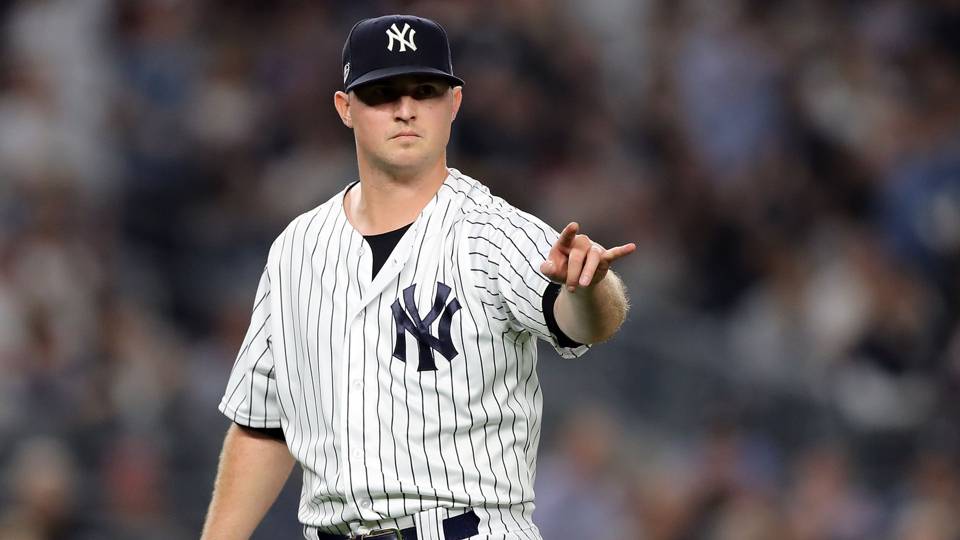
Meet the 2019 Yankees: Zack Britton


The New York Yankees went out and traded for Zack (no longer Zach) Britton during the summer of the 2018 season not only to bring his immense talent to their own ball club, but to also keep his left-handed throwing arm away from rivals like the Boston Red Sox and the Houston Astros. The Yankees liked what Britton brought to the table so much, and vice versa obviously, that on January 6, 2019 the team brought him back on a somewhat complicated three-year (maybe four…. maybe two) deal worth $39 million (or $50 million… or $26 million). Let’s meet the man that will likely be pitching the 8th inning (or the 7th inning… or the 6th inning… or the 9th inning) out of the bullpen this season for the 2019 New York Yankees, Zack Britton.

Zack Britton, 31-years old, is a left-handed throwing relief pitcher that stands 6’3” and weighs in at 195 lbs. Britton possesses a 95 MPH sinker, an 82 MPH curve ball, and a rarely thrown 95 MPH four-seam fastball. Britton’s sinker generates an extremely high number of swings and misses as well as an extreme number of ground balls, both of which work well inside Yankee Stadium. Britton also misses a ton of bats with his curve ball as well, although his fastball leaves much to be desired statistically.


Zachary Grant Britton was born on December 22, 1987 in Panorama City, California. Britton was raised by his family in Santa Clarita, California along with two older brothers. Britton attended Canyon High School for his freshman year where he sustained fractures of the skull and clavicle as well as bleeding in the brain as a result of diving headfirst into a concrete wall while attempting to catch a foul popup furing baseball practice with the team. Britton spent two days in intensive care due to the injuries. Britton was then moved by his family to Texas where he transferred to Weatherford High School. While at the school, Britton was an all-state outfielder for the team and also doubled as a pitcher. Britton was offered an athletic scholarship to attend Texas A&M University. Britton never took advantage of that scholarship from the Aggies, instead choosing to sign with the Baltimore Orioles who drafted him in the third round, 85th overall, in the 2006 MLB First Year Players Draft. Britton signed a $200,000 signing bonus and immediately began his professional career with the club. 

Britton worked his way through the Orioles minor league system from 2006 – 2011 before getting his MLB call up on April 3, 2011. Britton, then a starter, was called up to replace the injured Brian Matusz in the starting rotation for the Orioles. Britton was ultimately sent down on July 9th of that season after losing six of his last seven decisions after winning his MLB debut, some would speculate so that the Orioles could delay his free agency by a season by manipulating his service time, and finished his rookie campaign with a 4.61 ERA, a 1.45 WHIP and an 11-11 record in a total of 28 games. Britton returned in 2012 to make 11 starts, but had his season cut short because of a left shoulder impingement that landed him on the disabled list until July. Britton made another seven starts for the Orioles in 2013 over 40 innings of work before the team ultimately decided to move the left-hander to the bullpen.


The 2014 season was the first season that Britton worked solely as a reliever for the Baltimore Orioles after winning a spot on the club’s Opening Day roster. Britton would assume the closer’s role for the team and finished his first season as a closer converting 37 of 41 save opportunities with a 1.65 ERA. Britton also helped the Orioles sweep the Detroit Tigers in the 2014 ALDS, picking up a pair of saves, before losing to the Kansas City Royals. Britton would be selected to his first career All-Star Game in 2015 after saving 23 of 24 games in the first half and would finish the year with 36 saves and a 1.92 ERA. Britton would continue his string of success as a closer in 2016, opening the season with 19th consecutive saves, setting a new Orioles franchise record. Britton stretched that streak to 29 games to close out the first half of the 2016 season and made the All-Star team for the second consecutive season. Britton saved his 33rd straight game on August 3rd, setting an MLB record for most consecutive saves to start a season by a left-handed pitcher, while he also set an MLB record for most consecutive relief appearances without allowing an earned run, 39 at that point, on August 11th of 2016. Britton finished the season with 0.54 ERA in 67 innings (69 games) along with 74 strikeouts and a 0.84 WHIP. Britton saved all 47 of his save chances in 2016 en route to winning the Mariano Rivera Award and a fourth-place finish in the AL Cy Young Award balloting, receiving five first-place votes.

Britton would open up the 2017 season with a save, the 50th consecutive save dating back to October 1, 2015, becoming just the fifth pitcher in MLB history to convert at least 50 consecutive save opportunities. Britton would reach 54 consecutive saves before being added to the 15-day disabled list with left forearm tightness. Britton would convert his 55th consecutive save after two separate stints on the DL with the forearm and would stretch the streak up to 60 games before the Oakland Athletics broke the streak after an impressive 704 days. Britton would end the 2017 season making only 38 appearances out of the bullpen. It was later revealed that Britton had suffered a ruptured Achilles tendon, ruling him out of play for at least six months. Britton opened the 2018 season on the 60-day disabled list and would not make his debut until June 12th of that season. Britton spent a month with the Orioles before Baltimore shipped him to the New York Yankees in exchange for Dillon Tate, Cody Carroll, and Josh Rogers.


Now the Yankees and their fans get to see what a full, healthy season of Zack Britton really looks like here in 2019. Welcome back to the team, Zack, and welcome back to the family!!

Wednesday, February 13, 2019

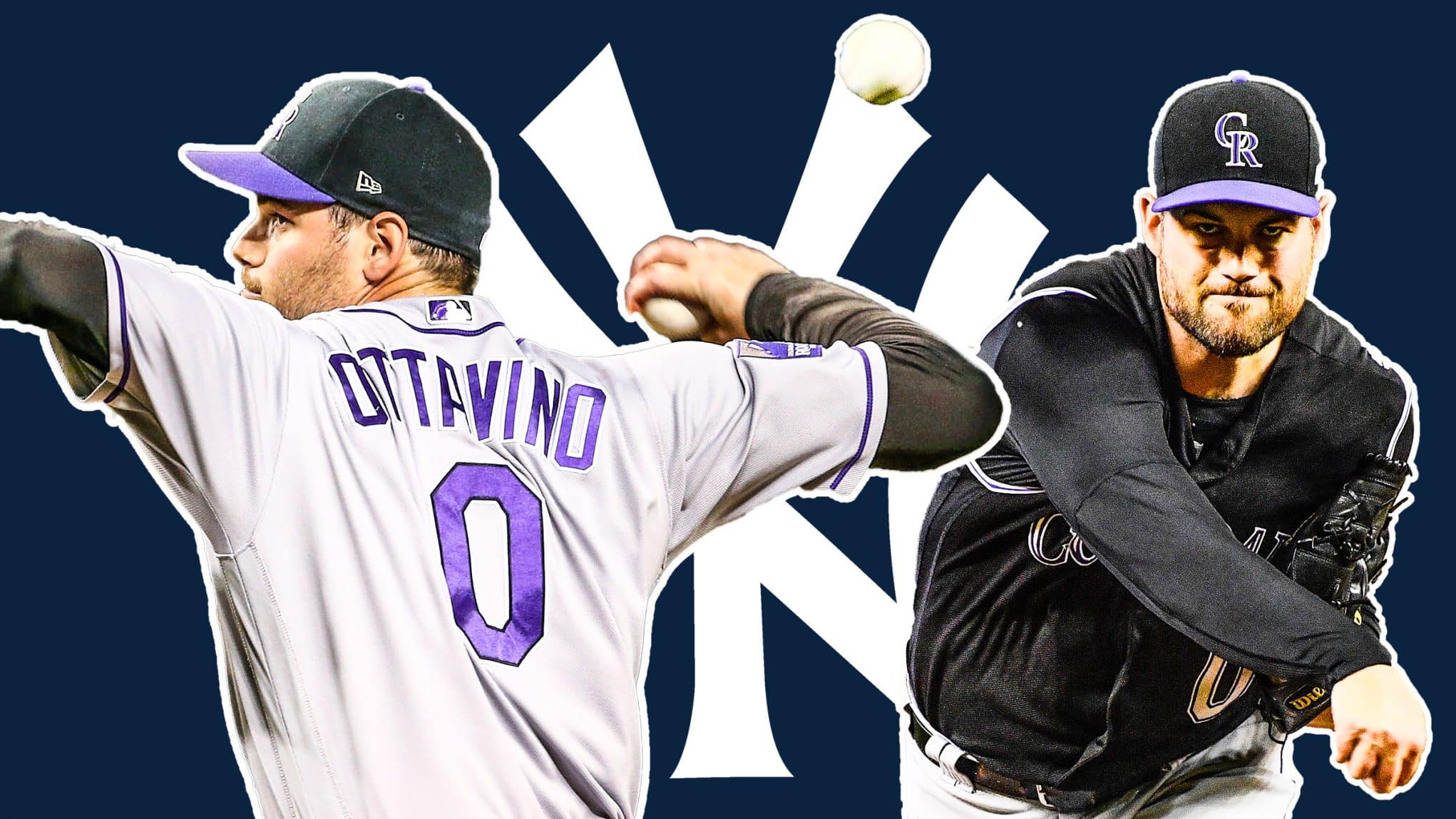
Meet the 2019 Yankees: Adam Ottavino


The New York Yankees completed their super bullpen this offseason when they signed a right-hander originally out of New York named Adam Ottavino. Ottavino was signed to a three-year deal worth $27 million by the Yankees on January 24, 2019 to essentially replace the recently departed David Robertson in the pen. Ottavino was the first ever Yankee to be awarded the “0” uniform number, which is essentially the last single digit uniform number in the Yankee’s history. Let’s meet the man that should be giving Gary Sanchez absolute fits all season long. Let’s meet your 2019 Yankees. Let’s meet Brooklyn-native Adam Ottavino.

Adam Ottavino, 33-years old, is a right-handed pitcher that will stroll in from the Yankees bullpen with his 6’5” and 220 lb. frame all season long in the 6th, 7th, 8th, and 9th innings. Ottavino’s pitching sequence includes an 82 MPH slider, a 95 MPH sinker, an 88 MPH cutter, a 94 MPH four-seam fastball and a 90 MPH changeup that he uses from time-to-time. Ottavino is all movement and deception and will give Yankees catcher Gary Sanchez a nice challenge behind the dish with this repertoire. For what it’s worth, not that I think Ottavino will see much of the plate for the Yankees, Adam is also a switch-hitter, which may explain why the Yankees didn’t sign more left-handed hitters this winter. Ottavino can balance the lineup!

image credit Elite Sports NY

Adam Robert Ottavino was born on November 22, 1985 in Brooklyn, New York where he attended P.S. 39, The Henry Bristow School in the Park Slope neighborhood. Ottavino remained in Brooklyn throughout his High School years where he graduated from Berkley Carroll School. While at Berkley Carroll the right-handed pitcher caught the eye of the Tampa Bay Rays who selected Ottavino in the 30th round of the 2003 MLB First Year Players Draft. Ottavino did not sign with Tampa and instead headed to Northeastern University to play college baseball for the Northeastern Huskies. While at Northeastern, Ottavino was able to compile both the single-season and all-time strikeouts records for the school while also earning the honor of being named American’s East Conference’s Pitcher of the Year in 2005.

After the 2005 season the St. Louis Cardinals came calling in the first round, 30th overall, of the 2006 MLB First Year Players Draft. Ottavino signed quickly and was immediately assigned to the Cardinals minor league system. Ottavino toiled around in the minor league system for St. Louis before making his MLB debut for the team as a starting pitcher in 2010. Ottavino was re-assigned off the team’s 40-man roster after five appearances but was ultimately added back to the team’s 40-man roster after the 2011 season. The Cardinals ultimately placed Ottavino on waivers before the 2012 season and the Colorado Rockies came calling, claiming the right-hander off waivers on April 3, 2012 and immediately assigned him to their minor league system.

Ottavino also represented Team Italy in the 2009 World Baseball Classic. Ottavino made one appearance during the tournament, pitching three scoreless innings against Team Venezuela. 


It was the 2012 season that saw the Rockies begin developing Ottavino as a relief pitcher. It was during the 2013 season that Ottavino changed his number on his uniform to 0, an ode to the “O” in Ottavino. Ottavino struggled mightily during his transition from starter to the bullpen in 2013 and 2014, but the right-hander was moved to the Rockies closers role in 2015 after Colorado learned that closer LaTroy Hawkins struggled early on. Ottavino was not in the closer’s role for long though, unfortunately, after a scan determined that Adam had torn his ulnar collateral ligament. The UCL injury required Tommy John surgery and it ended his 2015 campaign prematurely. Despite the injury the Colorado Rockies showed their commitment to Ottavino, signing him to three-year deal worth $10.4 million. Ottavino spent the first part of the 2016 season on the disabled list before coming back completely healthy in 2017. Ottavino broke out in his contract season of 2018 and headed into free agency off the heels of easily his best season in the Majors.

The Yankees came calling and snatched up Ottavino off the free agent market to solidify and complete their bullpen. Welcome back to the great state of New York, welcome to the greatest organization in all of professional sports, and welcome to the family, Adam.