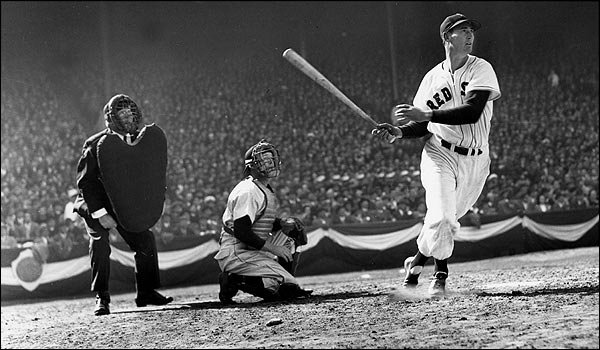
Showing posts with label Ted Williams. Show all posts

Thursday, November 15, 2018

2018 World Series Champions: The Boston Red Sox...

Photo Credit: Getty Images (Bob Levey)
Equates to VICTORY for Julia, not me...

I am writing this as a result of a lost bet with a die-hard Boston Red Sox fan named Julia (@werbiefitz). During the recent World Series, I took the side of my favorite National League team, the Los Angeles Dodgers, while Julia stayed with the team she has stood with since her childhood, the Boston Red Sox. The loser of the bet (which turned out to be me) was forced to read a book chosen by the winner. Upon completion of reading the book, the loser was required to write an essay about the ten things they learned from the book. Not a book review, that wasn’t really the point of the exercise, but rather how did the book affect you.  

The Red Sox won the 2018 World Series in five games to cap an incredible season which saw the team win a franchise high 108 games during the regular season. It represented the fourth World Series Championship for Julia since the Curse of the Bambino was broken in 2004. For me, it was a tough post-season. My favorite team, the New York Yankees, won 100 games but were eliminated in the ALDS by the Red Sox. Then, my favorite NL team gave me second life. A renewed opportunity to take down the mighty Red Sox. It was not meant to be and I suffered two heart-breaking series losses to Boston in the same October. Victory to Julia, and some book reading and an essay for me. I also had to change my FaceBook cover photo to one showing the Red Sox celebration for one week upon conclusion of the World Series.

The book Julia chose for me was Shut Out: A Story of Race and Baseball in Boston by Howard Bryant. At first glance, it would be easy to find the negatives in the book about the city of Boston and the Red Sox franchise, but admittedly, I found this a story of redemption.  


I was shocked almost from the start when I found out the Red Sox had the first opportunity in Major League Baseball to sign the great Jackie Robinson on April 16, 1945 but passed due in large part to racism that existed within the fabric of the franchise. I didn’t know former Red Sox owner Tom Yawkey but I do know that he hired his drinking buddies to hold key executive positions within the franchise and their racist beliefs prevented potential Red Sox teams that could have featured Jackie Robinson, Willie Mays and Ted Williams in the same lineup. It’s scary to think what the trio would have been capable of together. They certainly would have had a say in the great Yankees Dynasty of the 1950’s.  

I qualify this book as focused on the Red Sox but to believe that racism did not occur within the halls of other MLB organizations, including the New York Yankees, would be very wrong. Even the Dodgers organization, as the first team to feature a black player on its roster in 1947, was later marred by the racist words of their former General Manager, Al Campanis, who was fired in 1987.  The book briefly mentioned Elston Howard, who was the first and sadly only black player on the Yankee rosters for years during the 1950’s. Howard later played for the Red Sox.  

Tom Yawkey purchased the Red Sox in 1933. Yawkey had admired Eddie Collins, a former second baseman with the Philadelphia Athletics and Chicago White Sox, and appointed him as the team’s vice president and general manager when he took over control of the team. Collins had been with the White Sox during the infamous Black Sox scandal of 1919 when they threw the World Series to the Cincinnati Reds but Collins had been cleared of any wrongdoing. In 1935, Yawkey traded for Washington Nationals shortstop Joe Cronin, developing close friendships with both Collins and Cronin. From basically 1933 through 1958, Collins and/or Cronin controlled all player movement within the Red Sox organization. With these two men, I believe, Yawkey tarnished his legacy. Whether he was racist or not is not really the point, he allowed racism to exist to the detriment of the city and the franchise and that makes him responsible.   

After passing on Jackie Robinson in 1945, the Red Sox had a unique opportunity to sign Willie Mays four years later due to an exclusive lease arrangement that existed between a Red Sox affiliate, the Birmingham Barons, and the Negro League’s Black Barons. Cronin, by that time the GM for the Red Sox, had been tipped off about the incredible talents of the 18-year-old Mays and he sent a reluctant and racist scout to Alabama to watch Mays. According to stories, it rained for three days and the scout sent the Red Sox front office a negative review, perhaps without ever laying eyes on the legendary Say Hey Kid. It was another missed opportunity for the Red Sox, although I am sure the New York/San Francisco Giants didn’t mind.  

The Red Sox were the last Major League Baseball team to add a black player to its roster. While the rest of the Major League teams were slowly starting to integrate, it would take the Red Sox over a decade before they would finally add a person of color to their team. Elijah “Pumpsie” Green, Jr. was born in Richmond, CA (East Bay near Oakland) in 1935. His brother, Cornell, someone I’ve been aware of since my childhood, was a star defensive back for the Dallas Cowboys. However, I never knew who Pumpsie Green was until reading the book. Fighting through racism within the organization and at the team’s training facility in Scottsdale, Arizona, Green believed that he was going to open the 1959 season as the first black player for the Red Sox. At the eleventh hour, one of the noted racists within the Red Sox organization, manager Mike “Pinky” Higgins demoted Green to the minor leagues. Fortunately, it would prove to be a temporary decision. Higgins was fired 73 games into the ’59 season and replaced by Bill Jurges.  By that time, Eddie Collins was dead and Joe Cronin had left the Red Sox to become President of the American League. Green finally got the call to join the Red Sox later during the summer and on July 21, 1959, Pumpsie became the first African American player to take the field for the Red Sox when he was inserted as a pinch-runner for Vic Wertz and stayed in the game to play shortstop in Boston’s 2-1 loss to the Chicago White Sox. After the game, Green wept in the clubhouse. I cannot begin to imagine the emotions he must have felt that day.   


On a side note about Pumpsie Green, Red Sox Hall of Famer Ted Williams routinely warmed up with Green before games. It became a superstition for Ted but for Pumpsie, he remembered Williams as one of few who treated him both as a ballplayer and a man. I personally haven’t followed Red Sox history, but the way Williams approached Green gives me newfound respect for the Hall of Famer.  

Photo Credit: AP
Pitcher Earl Wilson might have been the first African American player for the Red Sox if not for a two-year military commitment. Originally drafted as a catcher, Wilson blossomed as a hard-throwing pitcher and roomed with Pumpsie Green for a time. But for Wilson, the Red Sox years were hard ones. After the ’59 season was over, Tom Yawkey fired Billy Jurges and restored the racist Pinky Higgins as manager. As their careers moved into the early 1960’s, Green’s career was quietly coming to a close (the lack of consistent playing time prevented him from realizing his potential) while Wilson was becoming more prominent. In 1962, Wilson (12-8, 3.90 ERA) threw a no-hitter against the Los Angeles Angels. 

Photo Credit: AP
When Yawkey fired Higgins as manager in 1962, Wilson felt Yawkey was finally opening his eyes to what a divisive man Higgins had been. Unfortunately, Yawkey surprised everyone by making Higgins his general manager.  Higgins was the GM in June 1965 when the Red Sox traded Earl Wilson to the Detroit Tigers along with Joe Christopher for Don Demeter and Julio Navarro. Wilson won 22 games for the 1967 Tigers, although the Tigers finished a game behind The Impossible Dream Red Sox that year, and he accumulated 338 victories overall for his career. Although Wilson lost Game 3 of the Series, he celebrated a World Series Championship with the Tigers in 1968. It’s sad that a pitcher primed for tremendous MLB success in Boston saw his greatest days in Detroit.  

In a twist of irony, Tom Yawkey fired Pinky Higgins as GM on September 16, 1965, the same day Red Sox pitcher Dave Morehead tossed a no-hitter against the Cleveland Indians. After his firing, while in Louisiana, Higgins drove his car into a group of black highway workers. He killed one man, a white World War II veteran and injured three others. He was charged with driving while intoxicated and sentenced to four years. However, he was paroled after serving only two months in 1969. But just two days after his release, Higgins dropped dead from a heart attack. As Earl Wilson would say while in Detroit when asked to comment on his former manager, “Good things happen to some people”. 

I was appalled to learn that The Elks Club, as recently as the 1980’s, condoned racism. The Elks Club in Winter Haven, FL, the site of Red Sox spring training at the time would issue invitations to white players, but not the blacks. Growing up in the Midwest in the 70's, my step father was an active member of The Elks Club and served as the Exalted Ruler for the local chapter in my hometown in 1978. I was unaware the organization condoned racism and I am deeply saddened to have been connected to such a pitiful organization. I may have been a kid but I feel a responsibility that I should have known better. I only hope that my step-father's chapter did not practice racism like the Winter Haven chapter did. My mother and step-father have passed away so it is not a discussion I can have with them.  

To back up a little, I vividly recall when Jim Rice and Fred Lynn burst onto the Major League scene for Boston in the mid-70's. They were great players from the start.  Living far away in the Midwest, I didn't see how the players were treated differently in their own city. Jim Rice, backed by his superior talent, had the power to be a major voice for the black community but it wasn't his personality.  He was introspective and to the media, he was unfriendly and considered sullen. I know Rice has gotten into tiffs with Derek Jeter and CC Sabathia over the years for whatever reasons, but I am not trying to indict the man. He was an incredible ball player. In a career spent entirely in Boston, Rice hit 382 home runs and drove in 1,451 runs. His career batting average was a healthy .298 and he had 2,452 hits in a career that spanned from 1974 to 1989. He was an eight-time All Star, AL MVP in the Bucky "F**king" Dent year of 1978, a two-time Silver Slugger Award winner, three-time AL home run leader, and two-time AL RBI leader. Yet, his number (14) was not retired by the Red Sox until two days after his Hall of Fame induction in July 2009. No one wore the number after his retirement but still, Rice is among the Red Sox Legends and deserved better treatment. Rice was charitable and a humanitarian. I think he is misunderstood because of his personality and I'd like to think he could have done more to help pave the way for black players in Boston, but there is no denying the man was one of the best in the history of the Red Sox to pick up a glove, bat and ball.  Noted baseball columnist Peter Gammons believed history would have been significantly different had Rice taken an active role in voicing his thoughts about the climate and culture of the Red Sox organization. To Rice's defense, I'll use this quote from the book's author: "Had Rice been white, he would have been lauded as a modern-day Gil Hodges: strong, silent, important. Being black, though, meant Rice was moody, arrogant and distant."  These words prove to me that I have absolutely no idea what it was like to walk in Jim Rice's shoes.  

Photo Credit: Boston Globe (Stan Grossfeld)
The next great superstar in the Red Sox organization was slugger Mo Vaughn. He was drafted in Rice's last year in 1989. For an organization that had featured so many outsiders over the years, Vaughn was a New Englander. He was from Norwalk, CT and had frequently visited Boston while growing up.  He was hailed as the first local Red Sox star since Carlton Fisk. As a Yankees fan, I despised Vaughn coming to the plate, much like how I'd later feel about David “Big Papi” Ortiz or more recently, Mookie Betts. These men knew/know how to use Fenway Park to their full advantage. 

Vaughn was the AL Most Valuable Player in 1995.  The city of Boston accepted Vaughn as their own and he was able to transcend the issue of race in his city.  Vaughn loved the city of Boston and wanted to spend his entire career there. The GM at the time, Dan Duquette, brought an era of diversity to the Red Sox. He corrected many of the wrongs committed by previous regimes and reconnected with former black players like Tommy Harper, Dave Henderson, Reggie Smith, and Jim Rice. But for all his positives, Duquette had his faults. He had a reputation of being difficult to work with and he frustrated those who worked for him. The relationship between Duquette and Vaughn became irreparable in 1998 when Vaughn was led to believe that he would be offered four-year contract for approximately $42 million (Peter Gammons believed they had reached agreement). Yet, when the offer came, it was only two years for $17 million. Using the media, the Red Sox orchestrated a smear campaign on the popular Vaughn. Vaughn had put together six monster years for the Red Sox, but on November 25, 1998 as a free agent, he left the team to sign a six-year, $80 million contract with the Anaheim Angels. It was a sad day for Boston and for Baseball in general. Vaughn was not a So-Cal kind of guy. He was a New Englander who should have called Fenway Park home for his entire career. I certainly do not feel that Dan Duquette is a racist but this might have been one of the saddest stories while reading the book.  


On February 22, 2002, the legacy of Tom Yawkey was ended when John Harrington sold the club to an ownership group led by John Henry, Tom Werner and Larry Lucchino. It brought much needed closure for the Yawkey Era, and it set the Red Sox on a path that has yielded four World Series championships in fourteen years. Before reading the book, I am not sure that I fully understood the huge impact John Henry has had on the Red Sox organization and how he has, through actions and not just words, rebranded the Red Sox organization into an exemplary model of professionalism and class. Well, maybe not for Yankee fans like me, but the current ownership group should be applauded for making a difference.  


As Julia pointed out to me, while the history of the Red Sox organization wasn't always pretty, the other Boston sports franchises were ground-breakers with integration. Willie O'Ree is referred to as the "Jackie Robinson of ice hockey" (the first black player in the NHL). He made his NHL debut with the Boston Bruins on January 18, 1958. Chuck Cooper became the first black player drafted in the NBA when he was selected with the first pick in the second round of the 1950 NBA Draft by the Boston Celtics. Legendary Celtics coach/executive Red Auerbach put together the NBA's first all-black starting five in 1964. In the inaugural American Football League draft in 1960, the Boston Patriots selected running back Ron Burton in the first round as their first-ever pick. Rommie Loudd became the AFL's first black coach when he was named linebackers coach for the Patriots in 1966. Loudd later became the first black top executive in major league sports as the owner of the World Football League's Florida Blazers in 1974.

There is so much more to the book than I've touched on with this short essay. Racism continues to be a big part of our everyday life in 2018 and it must stop. We've made some progress, but we are not where we need to be. We live in a current climate of hatred and blame which allows racism to survive. If I have one wish, it is a hope and prayer I live to see the end of racism as we know it. Even this week, there were reports out of the Seattle Mariners organization that their former Director of High Performance, Dr. Lorena Martin, has made allegations of derogatory comments made by GM Jerry DiPoto, Manager Scott Servais, and Director of Player Development Andy McKay with racial and sexist overtones. Maybe it is a case of a disgruntled former employee, but maybe it is not. Where there's smoke, there's generally fire. If true, this is unacceptable behavior that cannot be tolerated. I think all of us want a better tomorrow for our children and their children. The work to make it happen starts here.  No looking back, the focus should be on now and the future, and how we can help each other be successful and live meaningful, rewarding lives.  As they say, none of us are getting out of here alive.  We should live these days to the best of our ability and to share love and happiness around the World.  


That’s a wrap. While I wish that I had won the bet with Julia, I learned a great deal from the book and hopefully I can be a better person as a result. Enjoy your World Series championship, Julia. Your team earned it. But rest assured, the New York Yankees will be back, stronger than ever in 2019.  Until next time…

Tuesday, November 22, 2016

This Day in New York Yankees History 11/22: Enter Goose Gossage


On this day in 1977 the Yankees signed Rich "Goose" Gossage to a six year deal worth $2.75 million as a free agent. Gossage was coming off of a 26 save and 1.26 ERA season with the Pittsburgh Pirates.

Also on this day in 1957 Mickey Mantle edges out Red Sox superstar Ted Williams for the Most Valuable Player award for the American League. Two Chicago writers had Williams ninth and tenth on their respected ballots which slipped Ted to second place even though he had a .388 average with 38 home runs and a .731 slugging percentage.

Friday, November 11, 2016

This Day in New York Yankees History 11/11: Joe DiMaggio


On this day in 1941 Joltin' Joe DiMaggio won the American League Most Valuable Player award for the second time in his career. The Yankee Clipper edges Ted Williams in his season in which he hit .406 when a Red Sox writer leaves Williams off the ballot. The Curse of the Bambino continues...


Speaking of Joe DiMaggio on this day in 1948 the Yankee Clipper was put into John Hopkins Hospital in New York to remove bone spurs on his right heel. DiMaggio would not make his debut for the Yankees in 1949 until June, 28 of that season and would debut by hitting a single and a two run home run in his first two at bats in a 5-4 victory over the Red Sox in Fenway.

Tuesday, July 12, 2016

Meet a Prospect: Tony Gwynn


In honor of tonight’s 2016 MLB All-Star Game which is being hosted by the San Diego Padres inside their beautiful Petco Park I wanted to honor one of the fallen legends from not only the Padres but from Major League Baseball as well. I’m not great with words, toasts and all that jazz to be completely honest and this is the only way that I know how, or the best way anyway. This is Meet a Prospect: The Tony Gwynn Edition.

Anthony Keith “Tony” Gwynn Sr. was born on May 9, 1960 and passed away on June 16, 2014. In his untimely death “Mr. Padre” was battling cancer and had undergone radiation treatments that deemed him cancer free. It was the day before Father’s Day 2014 when Gwynn went into cardiac arrest and died from complications with the cancer far too soon. Gwynn’s family linked his cancer to his chewing tobacco as a young man and MLB player so Gwynn leaves a legacy and a message not only with his playing career but with his life as well. Gwynn played 20 seasons of MLB all for the San Diego Padres and in that time won eight batting titles with his career .338 batting average and never hit below .309 in any full season. Gwynn was a 15-time All-Star, a seven time Silver Slugger Award winner and a five time Gold Glove Award winner. Gwynn led the Padres to the franchise’s only two trips to the World Series and was inducted to the MLB Hall of Fame in his first year on eligibility in 2007. Gwynn was a truly remarkable baseball player and a truly remarkable man. Let’s meet him again.

Gwynn was born in Los Angeles, California to mother Vendella and father Charles Gwynn where he and his brother Charles Jr. found their love of sports, particularly basketball and baseball. Gwynn attended Long Beach Polytechnic High School and played for the school’s basketball and baseball teams there and while at the school Gwynn actually considered quitting baseball at one point. See his high school basketball team had a 53-6 record in his final two years of high school while his baseball team went a staggering 3-25-2. Gwynn received scholarships to play college basketball but none for college baseball despite hitting .563 in his senior year and went undrafted in the 1977 MLB Draft. Gwynn decided to go to San Diego State University to continue his career in both sports.

While at SDSU Gwynn played three seasons of baseball and four seasons of basketball earning two-time All-American honors as an outfielder in his final two years of baseball. Gwynn was not allowed to play baseball as a freshman due to being overweight according to his coaches. Gwynn impressed playing left field with SDSU and caught the eye of the San Diego Padres who came calling in the third round of the 1981 MLB Draft. Gwynn was selected 58th overall only before being drafted by the San Diego Clippers in the 10th round of the NBA Draft as well. It did not take Gwynn long to fly through the Padres system and wear the “ugliest uniforms he had seen in his life” (a quote he used before the draft and before becoming a member of the Padres) as he made his MLB debut in 1982.

Gwynn was first invited to Padres spring training camp in 1982 where he impressed with a .375 average but the outfield was set in San Diego that season pushing Gwynn to Triple- A to begin the season. Gwynn spent 93 games in Triple-A hitting .328 before earning his call up in place of a slumping Ruppert Jones. Gwynn finished his rookie campaign with a .289 average in 54 games due in large part to a wrist injury that cost him three weeks of his season. This would be the only season he would ever hit under .300 in a single season. Gwynn would become an All-Star for the first time in his first full season in 1984 and the San Diego Padres went on to also win their first NL West Division title. That season Gwynn also set the Padres single-season record for hits with 213 and finished third in the NL MVP Award voting behind Ryne Sandberg and Keith Hernandez. To finish off Gwynn’s breakout season he led the Padres to their first ever trip to the World Series, and eventual loss to the Detroit Tigers.

From 1985 throughout the rest of his career Gwynn was a staple in the Padres outfield, at or near the top of their lineup and at or near the top of the National League’s batting average list. Gwynn did not let the off-the-field drama affect his play which was a worry of some in 1987 when Gwynn filed for bankruptcy during the season. Gwynn remained steady and remained true to his form, being a contact hitter and not a power hitter, through the 1990’s. It was 1990 when Jack Clark accused Gwynn of being a selfish player worried more about his batting average than his team and winning. Clark mentioned that Gwynn should be swinging with runners in scoring position instead of bunting because Clark saw it as a way of manipulating his batting average if he failed while Gwynn though moving the runners over would help his team win. Whoever was right remains to be seen but Gwynn took the criticism personally forcing him to become distrustful and withdrawn from his teammates. Rumors began circulating that he may be traded after adjusting his style and swing with runners in scoring position and the cherry on top of the sundae was found in September of 1990. Gwynn found a figure of his likeness hanging in the Padres’ dugout and while San Diego said a groundskeeper was to blame Tony always knew in his heart it was Clark trying to send him a message.

Clark left for the Boston Red Sox before the 1991 season and the Padres tried to show their star some appreciation by signing him to a three-year contract extension with 412.25 million which included a $1 million signing bonus. The injuries continued to pile up for Gwynn as he ended the 1992 campaign on the disabled list, the third straight year he had done so, but that did not stop Gwynn from meeting Ted Williams on the field during the 1992 All-Star Game. Dealing with injury after injury was hard for Gwynn but the 1993 season may have been his toughest time in the major Leagues during his career. The Padres lost 101 games and finished just behind the Colorado Rockies in the division who were in their first year as an expansion team. Gwynn also watched many of his teammates including Gary Sheffield and Fred McGriff traded away but Gwynn remained the staple in San Diego. That season Gwynn did collect his 2,000th hit, almost had a 7-for-7 game and lost his father at just 57-years old due to heart problems. The roller coaster career continues.

Gwynn contemplated leaving the game in 1994 and leaving San Diego as well but he stuck it out and had possibly the best season of his career with his father behind him spiritually rooting him on. Gwynn chased down the .400 mark falling just short that season hitting .394 before losing the rest of the season and the World Series to the strike. Gwynn finished the season due to the strike just three consecutive hits away from hitting .400. Gwynn won his seventh batting title in 1997 but ended up spending a bulk of the season on the disabled list once again while the Padres lost in the postseason to St. Louis. Gwynn was back with vengeance in 1998 though leading the Padres to 98 victories and a trip to their second World Series against the New York Yankees. New York swept the Padres in four games in that series but that was not because of Gwynn’s lack of hitting. Gwynn finished that World Series hitting .500 while the rest of the team batted just .203 against Yankees pitching and even hit a home run against David Wells in the Bronx. This was as close as Gwynn ever got to a World Series victory and ring.

In 1999 Gwynn got to scratch two items off his bucket list, one was escorting Ted Williams around Fenway Park during the All-Star Game and the other was notching his 3,000th hit. Gwynn turned 40-years old in 2000 and had another season ending surgery which led to a bitter contract negotiation that left Gwynn a free agent for the first time in his career. The Padres wanted to buy out his deal to save the team $4 million but ultimately the team gave Gwynn $2 million of that back after signing him to a one-year deal with incentives that could have pushed the deal to $5.7 million. Injuries continued to pile up for Gwynn until the future Hall of Fame hitter announced his retirement at the end of the season on June 28, 2001.


Tony Gwynn was elected to the MLB Hall of Fame in Cooperstown, New York in his first year of eligibility in 2007 and passed away in 2014. Gwynn was the epitome of class, hard work and what it meant to play Major League Baseball. He is missed to this day around the league and will always be missed by anyone who was a fan of MLB during that era, especially myself. Rest in peace Tony and just know even today and even as a Yankees fan we’re still thinking of you and what you meant to the game. Fly high!

Sunday, November 22, 2015

This Day in New York Yankees History 11/22: Enter Goose Gossage


On this day in 1977 the Yankees signed Rich "Goose" Gossage to a six year deal worth $2.75 million as a free agent. Gossage was coming off of a 26 save and 1.26 ERA season with the Pittsburgh Pirates.

Also on this day in 1957 Mickey Mantle edges out Red Sox superstar Ted Williams for the Most Valuable Player award for the American League. Two Chicago writers had Williams ninth and tenth on their respected ballots which slipped Ted to second place even though he had a .388 average with 38 home runs and a .731 slugging percentage.

Wednesday, November 11, 2015

Interested in Some Invaluable Yankees Memorabilia?


Displaying Yankees.jpg

You guys know us by now here at TGP. We're humble and we are the first ones to lend a helping hand when someone needs it or asks for it. I was checking my email yesterday when the group over at Invaluable.com reached out to us and asked if we would be willing to inform our readers about an MLB memorabilia auction that goes live on November 14th and of course we were willing to help. This isn't the first time we've worked with the crew over at invaluable and we received some nice feedback from the first post so I am bringing you a second post this afternoon here on the blog.

Invaluable.com is an online marketplace that brings your rare baseball memorabilia live from the Louisville Slugger Factory and Museum. The auction will be live on November 14th at 11:00 am ET. There will be something for everyone from baseball bats from Yankees legends like Yogi Berra to 19th century baseball artifacts. The range of pricing for these bats and memorabilia range anywhere from $100-$250,000.

We receive nothing if you check out the auction and we still receive nothing if you buy. We truly wanted to just bring this to your attention because we thought you may be interested, it's not like we have baseball to watch or prepare for anytime soon, right?

Here are a few examples of what is up for auction on November 14th from invaluable.com


Lot 289: Fine Lou Gehrig professional model baseball bat c. 1930-31 (PSA/DNA graded "GU 8")

Estimated Price: $75,000 - $100,000

The bat originates from a primary source descendant of a former Washington area bat boy whom is believed to have spent time with several teams inclusive of the Washington Senators. According to family history, the young bat boy had the occasion to meet several notable individuals during this period and one particularly special encounter was with Lou Gehrig. The 1930-31 time period was particularly productive for Gehrig who turned in numbers that would have been career years for nearly any other player conceivable. A fresh to market Gehrig game bat is always noteworthy and an example with strong provenance and usage characteristics is an exceedingly rare find.


Lot 293: Fine 1931 New York Yankees team signed baseball

Estimated Price: $10,000 - $15,000

Red and blue stitched Reach W.Harridge Official American League baseball has been signed by (25) incl. Babe Ruth, Lou Gehrig, Tony Lazzeri, Lefty Gomez, Red Ruffing, Earle Combs, Bill Dickey, George Pipgras, Cy Perkins, Herb Pennock, Sam Byrd, and others. Joe Sewell and Dusty Cooke are clubhouse signed. All are done in period fountain pen rating 7-8 out of 10. Ball displays some mild toning and light evident usage wear with faded but well defined stampings. A choice example dating to this highly desirable period.


Lot 288: Rare 1929 New York Yankees vs. Philadelphia Athletics panoramic photograph

Estimated price: $1,500-$2,500

Original sepia tone image taken from the right/center field vantage point at New York’s Yankee Stadium during a game played between the Yankees and the Philadelphia Athletics. Beautiful image shows a full crowd watching the game played on June 22, 1929 with Babe Ruth clearly visible at bat under magnification. Image itself measures 8"x25" on original cabinet mount in three sectional images as commonly seen of the era. First such example we have handled or encountered with period Yankee Stadium panoramic photography seldom offered at auction.


Here's a few other items, there's definitely several more in the auction but these are top bids. Babe Ruth signed bat, 1956 signed Yankees baseball, and this Joe DiMaggio signed jersey. As always, feel free to check out the other sports memorabilia Invaluable has up for auction. You can share any of the information as well as the pictures attached on your site! We're excited about this auction, it's in its 12th year.

This Day in New York Yankees History 11/11: Joe DiMaggio


On this day in 1941 Joltin' Joe DiMaggio won the American League Most Valuable Player award for the second time in his career. The Yankee Clipper edges Ted Williams in his season in which he hit .406 when a Red Sox writer leaves Williams off the ballot. The Curse of the Bambino continues...


Speaking of Joe DiMaggio on this day in 1948 the Yankee Clipper was put into John Hopkins Hospital in New York to remove bone spurs on his right heel. DiMaggio would not make his debut for the Yankees in 1949 until June, 28 of that season and would debut by hitting a single and a two run home run in his first two at bats in a 5-4 victory over the Red Sox in Fenway.

Saturday, November 22, 2014

This Day in New York Yankees History 11/22: Enter Goose Gossage


On this day in 1977 the Yankees signed Rich "Goose" Gossage to a six year deal worth $2.75 million as a free agent. Gossage was coming off of a 26 save and 1.26 ERA season with the Pittsburgh Pirates.


Also on this day in 1957 Mickey Mantle edges out Red Sox superstar Ted Williams for the Most Valuable Player award for the American League. Two Chicago writers had Williams ninth and tenth on their respected ballots which slipped Ted to second place even though he had a .388 average with 38 home runs and a .731 slugging percentage.

Tuesday, November 11, 2014

This Day in New York Yankees History 11/11: All Joe DiMaggio


On this day in 1941 Joltin' Joe DiMaggio won the American League Most Valuable Player award for the second time in his career. The Yankee Clipper edges Ted Williams in his season in which he hit .406 when a Red Sox writer leaves Williams off the ballot. The Curse of the Bambino continues...


Speaking of Joe DiMaggio on this day in 1948 the Yankee Clipper was put into John Hopkins Hospital in New York to remove bone spurs on his right heel. DiMaggio would not make his debut for the Yankees in 1949 until June, 28 of that season and would debut by hitting a single and a two run home run in his first two at bats in a 5-4 victory over the Red Sox in Fenway.

Saturday, May 31, 2014

Can't Predict Baseball: Ted Williams & Carl Yastrzemski Link


On this day in 1961 the Red Sox pinch hit Carroll Hardy for Carl Yastrzemski. Hardy would bunt for a single in the eight inning of a 7-6 loss to the New York Yankees. The importance of the pinch hitter was that Hardy became the only player to pinch hit for both Yastrzemski and Ted Williams in their careers.

On this day in 1975 Cesar Tovar, for the fifth time in his career, got his team's lone hit in a game in which he broke up the Yankees Catfish Hunter's no hitter bid. Tovar singled in the sixth inning of the Texas Rangers 6-0 loss to the New York Yankees. The Rangers designated hitter also got the only Ranger hit in 1967 against the Senators Barry Moore, the only hit in 1968 against the Orioles Mike Cuellar, and in 1970 against the Senators Dick Bosman.


Sunday, May 25, 2014

Can't Predict Baseball: Ted Williams Goes Above .400


On this day in 1937 future Hall of Famer Mickey Cochrane's career ends after he is beaned by Yankees pitcher Bump Hadley. The Tigers catcher would spend six weeks in the hospital only to return later as a manager, not as a player.

On this day in 1941 Ted Williams goes 4-5 against the New York Yankees in Yankee Stadium to raise his batting average over .400 for the first time this season. Williams would finish the 1941 season batting .406.

Thursday, May 8, 2014

Understand Sabermetrics : On Base Percentage (OBP)

The entire premise of the movie Moneyball, and the whole moneyball craze, was the thought that defense did not matter, home runs did not matter, batting average did not matter, the only thing that mattered was getting on base. I , without doing hours of research and still not getting a 100% correct  answer, would say that OBP was the first SABR stat that started it all when it comes to being in the mainstream media and being used to calculate value for players. OBP basically calculates the players ability to reach base without the help of a fielding error, fielders choice, dropped third strikes, fielders obstruction, or catchers interference.


The highest OBP ever posted, career wise, was Ted Williams when he posted a .482 OBP. The lowest ever was .194 OBP by Billy Bergen. The highest total for a single season was Barry Bonds when he posted a staggering .609 OBP.


 Here is how OBP is calculated:

On-base percentage (OBP) = (H + BB + HBP) / (AB + BB + HBP + SF)

Basically what you do is add the players number of hits, walks, and hit by pitches, and put that number aside to be used later. You then add the number of at bats, walks, hit by pitches, and sacrifice flies while putting that number aside. You then will divide the first number you got by the second number you got and you will have the players OBP.


Let's use a Yankee's 2011 season stats as a way to hopefully simplify it. Let's use Nick Swisher only because he was the first "moneyball" player that Billy Beane ever drafted using the system because he was the only player that he and traditional scouts could agree on.


In 2011 Nick has 137 hits, 95 walks, and 5 hit by pitches adding up to 237.

He had 526 at bats, 95 walks, 5 hit by pitches, and 8 sacrifice flies adding up to 634.

You will then divide 237 by 634, getting Nick's OBP of .374.

The modern era league average for OBP is considered to be .340. A good way to measure a "good" OBP is to compare it to the players batting average. Nick's 2011 batting average was only .260, meaning he has a OBP 114 points higher then his batting average. Anything over 100 points higher then your batting average is above average at getting on base. Anything 50-100 points is considered below average to average. If it is possible to be below 50 points would mean you are terrible at getting on base. Nick Swisher, Mr. Money Ball, is a great example of what Billy Beane was trying to draft when this craze started.

Monday, November 11, 2013

This Day In New York Yankees History 11/11


On this day in 1941 Joltin' Joe Dimaggio won the American League Most Valuable Player award for the second time in his career. The Yankee Clipper edges Ted Williams in his season in which he hit .406 when a Red Sox writer leaves Williams off the ballot. The Curse of the Bambino continues...


Speaking of Joe Dimaggio on this day in 1948 the Yankee Clipper was put into John Hopkins Hospital in New York to remove bone spurs on his right heel. DiMaggio would not make his debut for the Yankees in 1949 until June, 28 of that season and would debut by hitting a single and a two run home run in his first two at bats in a 5-4 victory over the Red Sox in Fenway.

Monday, April 16, 2012

Is The Shift Just A Fad?

Is this going to be a regular site from here on out?

I was at the LoHud Yankees Blog reading the game notes from last night's victory over the Angels. I love anything that gives me a different perspective on things, which is why Pardon The Interruption is one of my favorite shows, and some times you can get that from those notes. This time, however, nothing really stood out. There were more notes on Jeter hitting well at the beginning of this season, which even he is getting tired of. There was some talk about Nova not geting rattled, and challenging hitters rather than trying to nibble at the plate (perhaps you heard the word "rock" used by some other guy, in reference to Super-Nova). But it was this note that caught my eye...
Girardi was asked about whether or not he’s had any discussions with Teixeira about adjusting to the shift. “You don’t,” he said. “You tell him to swing the bat, hit balls hard, and things will work out. It’s not like it’s something new to him this year.”

"...hit balls hard, and things will work out." I've thought the same thing, but hearing that made me think whether or not that's true. Seeing the shift against Teixeira when he bats from the left side made me wonder if that extra fielder made his batting average on balls in play (BABIP) go down. A quick trip to Baseball Reference answered that question.

I decided to look at 2011, as that was the year in which we saw the shift on Teixeira night in and night out. And it turns out that Mark's BABIP versus right-handed pitchers, while batting from the left-side, was only .222. Which is incredibly low when you figure that league average is usually around .300. Look at Tex's BABIP vs. LHPs, while batting from the right-side, which was .278. And this isn't a case of small sample size skewing the numbers, as Mark had 397 at bats from the left-side, and 189 at bats from the right-side, last season.

And the same thing is happening in 2012. Mind you, this time it could be small sample sizes playing tricks on us, but Teixeira's BABIP vs. RHP, as a left-handed batter, is a paltry .222. Batting from the right-side, and facing LHPs, that BABIP is .308. Even though Tex has only had 22 at bats vs. RHP, and only 14 at bats vs. LHP, I'm willing to bet that unless Mark stops being so pull-happy when batting from the left-side, that we're going to continue seeing him struggle when hitting from the left-side.

I was thinking about other pull hitters in Major League Baseball, and came across Ted Williams. Ted was a strong pull-hitter, who had a career BABIP of .328. Now, I'm not saying Williams wouldn't still be considered one of the better hitters in the history of the game, but what if teams employed the shift against Ted a lot more back then, like we see today? Keep in mind that Ted was not a switch-hitter like Teixeira is, as Williams was a left-handed hitter only. So it's not like Teddy Ballgame could just feast on left-handed pitching, sort of like how Teixeira still bats well against lefties from the right-side of the plate.

So this begs the question... "should Girardi start employing the shift more often too?"

I can hear shouts of "NO" coming from a number of Yankee fans. Now, certainly he shouldn't shift against every player, but if spread charts show that a batter is way more likely to hit the ball to one side, like Teixiera tends to pull the ball the vast majority of the time while batting left-handed, then it makes sense to do it. It would also help if the pitcher was able to hit his spots, unlike what we saw from Freddy Garcia in his first outing of 2012. If a pitcher is supposed to throw the ball inside to a left-hander, but the pitch goes to the outside of the plate, then it's going to be easier for the batter to go the other way and get a cheap base-hit (or, as I like saying, "bitch hits").

If Yankee pitchers can at least hit their spots, then don't be surprised if the team employs the shift more often this season.