Monday, November 17, 2014
Ten Biggest New York Yankees Contracts
With Giancarlo Stanton set to sign a record setting 13 year deal worth $325 million I got thinking of the Top 10 contracts that the New York Yankees ever handed out. Enjoy.
1.) Alex Rodriguez (10-years, $275 million, 2008-2017)
2.) Derek Jeter (10-years, $189 million, 2001-2010)
3.) Mark Teixeira (8-years, $180 million, 2009-2016)
4.) CC Sabathia (7-years, $161 million, 2009-2015)
5.) Masahiro Tanaka (7-years, $155 million, 2014-2020)
6.) Jacoby Ellsbury (7-years, $153 million, 2014-2020)
7.) Jason Giambi (7-years, $120 million, 2002-2008)
8.) Mike Mussina (6-years, $88.5 million, 2001-2008)
9.) Bernie Williams (7-years, $87.5 million, 1999-2006)
10.) A.J. Burnett (5-years, $82.5 million, 2009-2013)
Most Popular Article of the Week: Marlins & Giancarlo
Marlins and Stanton About To Make History
http://www.thegreedypinstripes.com/2014/11/marlins-and-stanton-about-to-make.html
It's not official yet, but pretty soon Yankees fans can take solace in the fact that their team no longer has the highest paid player in baseball history*.
Jon Heyman was the first to report that the Marlins and Giancarlo Stanton are about to finalize a 13 year contract worth $325 million.
It's hard to believe a team with a payroll under $50 million last season will pay one of their players $25 million (or that's what the average annual value of the deal would be), but if anybody in the league deserves that type of payday it's Giancarlo.
Stanton finished the 2014 season with a batting line of .288/.395/.555, to go along with 37 home runs. It was recently announced that he finished 2nd in National League Most Valuable Award voting behind Clayton Kershaw.
Jon Heyman was the first to report that the Marlins and Giancarlo Stanton are about to finalize a 13 year contract worth $325 million.
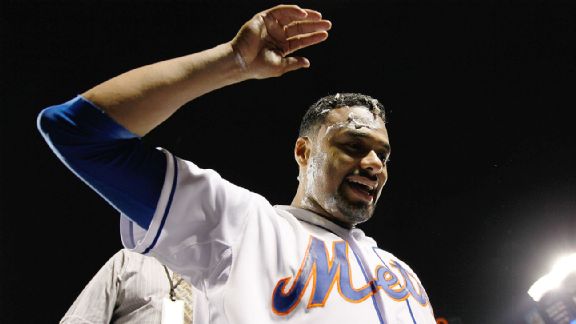
I'd be smiling pretty damn big too if I was about to make that much money.
It's hard to believe a team with a payroll under $50 million last season will pay one of their players $25 million (or that's what the average annual value of the deal would be), but if anybody in the league deserves that type of payday it's Giancarlo.
Stanton finished the 2014 season with a batting line of .288/.395/.555, to go along with 37 home runs. It was recently announced that he finished 2nd in National League Most Valuable Award voting behind Clayton Kershaw.
It's being said the not only will Stanton get the largest contract in baseball history, but his deal will include an opt-out clause. So the chances of seeing Giancarlo in pinstripes is not dead. Although, I'm afraid that it will be after the eighth year of his contract, when he'll be 35 years old and on the decline.
*Unfortunately, those same Yankees fans still have to come to terms with their team paying Alex Rodriguez $61 million over the next three years for next to nothing.
MLB Considering Instant Replay Changes to Speed Up the Game
From the Associated Press:
PHOENIX (AP) — Joe Torre was pleased with the first season of baseball’s replay challenge system, even if teams were not always sure what could be reviewed.
What the Major League Baseball executive vice president could have done without was all the on-field lingering by managers.
A successful first season in the books, MLB might look at tweaking replay challenges to prevent managers from stalling in the middle of the diamond while someone on the bench signals whether a call should be contested.
“When we first talked about challenges, if you got out of the dugout you couldn’t challenge, but I didn’t want to take away from the fact that the manager could run out there and argue,” Torre said Wednesday at the general managers’ meetings.
“I didn’t really plan on them meandering out there and having a conversation, but you live and you learn,” the Hall of Fame manager said.
MLB instituted a new replay system allowing a manager one challenge per game, another if that one is successful. Reviewable plays covered everything from force and tag plays to fan interference and home runs.
Though the new system was occasionally criticized for making long games even longer, most managers and players were pleased with the system — they just wanted the correct calls to be made.
But because a lot of the plays happen so quickly, managers would routinely go out to discuss a call on any close play to give their own video people time to run back the play. Some got carried away, lingering on the field, pretending to discuss the call with the umpires while awaiting word from the dugout whether to challenge the play or not.
Baseball is trying to cut down on the length of games, not add to them, so Torre said the rules committee has discussed ways to prevent that from happening.
“That’s one area we’ll do something differently,” he said. “I’m not sure what that is, but certainly we will eliminate some of that standing around because 10 seconds is a long time in our game.”
Length of games has been an issue in baseball for years and MLB is looking at way to speed up.
Baseball has been experimenting with pitch clocks in the Arizona Fall League, requiring hitters to stay in the batter’s box and pitchers to throw their next pitch within 20 seconds.
Some players in the league have complained about feeling rushed, but the games have been quicker, so MLB will take a look at possibly implementing some elements of the pace-of-play measures.
“This has been, just from all the evidence we have from the Fall League, a real positive as far as gathering information,” Torre said. “And that’s what we have to do in determining whether this will work.”
Baseball may also tweak the blocking-the-plate rule. The measure seems to have cut down on collisions and injuries, but has led to confusion on exactly what’s allowed.
Baseball clarified the rule late in the season, saying umpires should not call runners safe on a blocking call if the ball clearly beats them.
“Right now, we’re going to discuss in the rules committee and, along with the players’ association, see if we can make it a little clearer,” Torre said.
TGP Daily Poll: Yankees Will Sign Yoan Moncada
Vote in our poll!
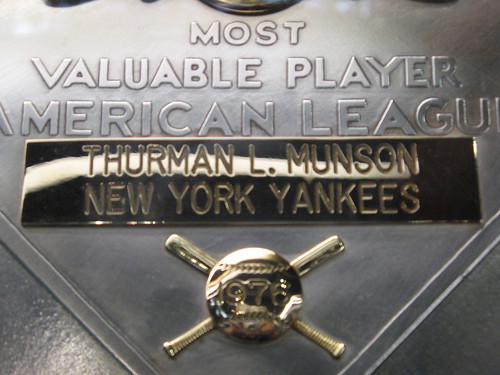
This Day in New York Yankees History 11/17: Thurman Munson is MVP
On this day in 1976 Yankees catcher Thurman Munson received 18 of the 24 first place votes to capture the American League MVP award.George Brett finished in second place and was no match for Munson's .302 average with 17 home runs and 105 RBI's. Munson is the first Bronx Bomber to be selected as the MVP and the Rookie of the Year, as Munson won the ROY in 1970.
Also on this day in 1964 the New York Mets signed former Yankees star Yogi Berra to a player/manager deal on a two year contract. The Yankees had recently just fired Yogi as a manager for them and will have to watch Yogi collect two more hits in nine National League at bats.
Sunday, November 16, 2014
Cashman: Refsnyder and Pirela Could Be 2015 Second Base Candidates
Yankees GM Brian Cashman sat down with the YES Network's Jack Curry recently, and seemed to have some interesting things to say when doing so.
According to Cashman, the Yankees may give infield prospects Rob Refsnyder and Jose Pirela a shot at the 2015 second base job, in spite of the fact that both of them are yet to play a full season in the big leagues. During the last two months of 2014, it should be noted, the team primarily used Martin Prado in the role, meaning that Prado may start elsewhere next year after all.
“As long as they’re developing, they’re going to get a chance,” Cashman said. “The last few years there’s been less of an opportunity because there have been less obvious candidates. We’ve had, to some degree, some failures, whether it’s in our development or our drafting or our signing internationally that caused a little bit of a black hole that everybody obviously knows and we acknowledge.”
Cashman also opined that "brighter days" are ahead for the Yankees' farm system, which was ranked the 23rd best in the league this season by Baseball Prospectus. He said that the Yankees have options now for the first time in years, young pitchers Jacob Lindgren and James Pazos included.
“There are some exciting players that are coming that, unfortunately, in years past, they just haven’t been — those guys were just down the line and we had a gap that existed in the system because of previous years’ failures,” he said. “But those have been shored up."
The aforementioned Refsnyder was the talk of the fanbase in the midst of Brian Roberts' struggles this season, hitting .300 with 8 home runs and 33 RBI in 77 games at Triple-A Scranton/Wilkes-Barre. Pirela, meanwhile, also impressed in nearly twice as many contests with the Railriders, batting .305.
Awards: IBWAA vs. BBWAA
As you know I am a member of the Internet Baseball Writer's Association of America, or the IBWAA, and we vote for all the major awards just like the Baseball Writer's Association of America (BBWAA) do. All this week I have posted the results from the IBWAA and I wanted to take a minute to compare them to the BBWAA results to see if we got them right. Enjoy.
| 2014 Awards - IBWAA vs. BBWAA | |||||
| AL | NL | ||||
| Rookie of the Year | Abreu/ Abreu | deGrom/deGrom | |||
| Manager of the Year | Showalter/Showalter | Williams/Williams | |||
| Cy Young Award | Hernandez/ Kluber | Kershaw/Kershaw | |||
| MVP Award | Trout/ Trout | Kershaw/Kershaw | |||
IBWAA pick on the left |
|||||
| BBWAA pick on the right | |||||
Tweaking The Challenge System
Yesterday, John Marshall of the Associated Press published an article that discusses the pace of play in Major League Baseball. While Marshall briefly talked about a couple of possible rule changes used in the Arizona Fall League, including a pitch clock, the bulk of the article talked about tweaking the challenge system implemented during the regular season in 2014.
While I believe some challenges took much longer than they should have, and the ruling after some of them left us scratching our heads, the system worked pretty well. In the past I've been opposed to any sort of replay, but finally came around to the idea that getting the call right should be the top priority.
My only true beef with the system had to do with managers coming out onto the field trying to kill time while their coaches looked at the replay to try and determine whether they should challenge a play or not. In case you don't know, managers can only challenge a maximum of two plays a game, assuming their first challenge is successful. So while I understand managers holding up a game to make sure they should challenge a play, that doesn't mean it doesn't get frustrating for spectators.
Thankfully Joe Torre, MLB's Executive Vice President, also sees this as a problem which needs to be addressed.
Ryan Mallet, quarterback for the Texans, threw a pass of about 20 yards to Andre Johnson that was ruled complete. However, replays showed that the ball hit the turf, meaning it should have been incomplete. The Texans tried to hurry up and snap the ball, which would eliminate the possibility of the Browns challenging the ruling of a completion, but Cleveland's coach threw the red flag... signifying that he was challenging the play... first. The officials determined that the ball had hit the ground, and reversed the decision to an incomplete pass.
You see what was different than what would have happened in MLB? No? Well, it's simple... play was not held up by anybody. The Browns coach didn't come out onto the field to argue, nor did the Browns defense do something to hold up the game. The speed of the game was no different whether Cleveland challenged the call or not.
I'd like to see something like this happen in MLB. Of course, some rules would have to change. One of them would be that, like Joe Torre brought up in that article, managers would not be allowed to challenge a play if they come onto the field. A challenge would have to be made from the dugout. I would think they'd have to throw some sort of flag, or have the next batter or pitcher signal to an umpire for the manager.
Another change would be a time limit on the pitcher and batter. The AFL tried out a pitch clock that could be used in MLB, but that would have to be combined with a time limit on how long a batter takes to get into the batter's box.
Those two changes could lead to managers in MLB having to make a decision about challenging a play without adding time to a game, like they did in the Texans/Browns situation I discussed earlier.
To be honest, I don't think the pace of play is a big deal. The NFL, and football in general, is the biggest spectator sport in the United States. However, a football game in the NFL or in college can take around three hours, while there may only be 15 minutes of actual action.
I believe the reason for declining ratings for MLB is because of the lack of offense. Face it, while big baseball fans such as myself will watch as many games as possible, while also paying for things like Extra Innings and MLB.tv, casual baseball fans want to see more runs. And offense has gone down in MLB over the years. But like so many other things, that's cyclical.
While run prevention rules MLB right now, leading to lower ratings, the opposite could be true in a few years. Teams like the Mets are doing things like moving in the outfield walls (again!), meaning it's entirely possible to see hitters ruling the game again, meaning MLB ratings will rise.
The bottom line is that MLB should not do anything to speed up the game that could hurt it. Pitcher/Batter clocks, along with eliminating arguments from managers, would not damage the game. I don't think people watch baseball, whether that be die-hard fans or casual ones, because they may see an argument from a manager, or because it takes a minute for play to continue due to batters or pitchers taking their time.
So go ahead and try to speed up the game, but don't get carried away.
While I believe some challenges took much longer than they should have, and the ruling after some of them left us scratching our heads, the system worked pretty well. In the past I've been opposed to any sort of replay, but finally came around to the idea that getting the call right should be the top priority.
Yeah, yeah.
My only true beef with the system had to do with managers coming out onto the field trying to kill time while their coaches looked at the replay to try and determine whether they should challenge a play or not. In case you don't know, managers can only challenge a maximum of two plays a game, assuming their first challenge is successful. So while I understand managers holding up a game to make sure they should challenge a play, that doesn't mean it doesn't get frustrating for spectators.
Thankfully Joe Torre, MLB's Executive Vice President, also sees this as a problem which needs to be addressed.
"When we first talked about challenges, if you got out of the dugout you couldn’t challenge, but I didn’t want to take away from the fact that the manager could run out there and argue.”
“I didn’t really plan on them meandering out there and having a conversation, but you live and you learn."
“That’s one area we’ll do something differently. I’m not sure what that is, but certainly we will eliminate some of that standing around because 10 seconds is a long time in our game,” Torre said Wednesday at the general managers’ meetings.I'm actually writing this while the Browns/Texas game is on the television, and a play that happened early in the game got me thinking about a solution.
Ryan Mallet, quarterback for the Texans, threw a pass of about 20 yards to Andre Johnson that was ruled complete. However, replays showed that the ball hit the turf, meaning it should have been incomplete. The Texans tried to hurry up and snap the ball, which would eliminate the possibility of the Browns challenging the ruling of a completion, but Cleveland's coach threw the red flag... signifying that he was challenging the play... first. The officials determined that the ball had hit the ground, and reversed the decision to an incomplete pass.
You see what was different than what would have happened in MLB? No? Well, it's simple... play was not held up by anybody. The Browns coach didn't come out onto the field to argue, nor did the Browns defense do something to hold up the game. The speed of the game was no different whether Cleveland challenged the call or not.
I'd like to see something like this happen in MLB. Of course, some rules would have to change. One of them would be that, like Joe Torre brought up in that article, managers would not be allowed to challenge a play if they come onto the field. A challenge would have to be made from the dugout. I would think they'd have to throw some sort of flag, or have the next batter or pitcher signal to an umpire for the manager.
Another change would be a time limit on the pitcher and batter. The AFL tried out a pitch clock that could be used in MLB, but that would have to be combined with a time limit on how long a batter takes to get into the batter's box.
Those two changes could lead to managers in MLB having to make a decision about challenging a play without adding time to a game, like they did in the Texans/Browns situation I discussed earlier.
To be honest, I don't think the pace of play is a big deal. The NFL, and football in general, is the biggest spectator sport in the United States. However, a football game in the NFL or in college can take around three hours, while there may only be 15 minutes of actual action.
I believe the reason for declining ratings for MLB is because of the lack of offense. Face it, while big baseball fans such as myself will watch as many games as possible, while also paying for things like Extra Innings and MLB.tv, casual baseball fans want to see more runs. And offense has gone down in MLB over the years. But like so many other things, that's cyclical.
While run prevention rules MLB right now, leading to lower ratings, the opposite could be true in a few years. Teams like the Mets are doing things like moving in the outfield walls (again!), meaning it's entirely possible to see hitters ruling the game again, meaning MLB ratings will rise.
Hopefully, this time, offense rises without the use of steroids or other PEDs.
The bottom line is that MLB should not do anything to speed up the game that could hurt it. Pitcher/Batter clocks, along with eliminating arguments from managers, would not damage the game. I don't think people watch baseball, whether that be die-hard fans or casual ones, because they may see an argument from a manager, or because it takes a minute for play to continue due to batters or pitchers taking their time.
So go ahead and try to speed up the game, but don't get carried away.
Johan Santana is a Free Agent Again
Johan came to camp after a second torn shoulder capsule, which the first one usually ends a pitcher's career, looking to latch on with a team on a minor league deal. Johan came out of the gates and showcased for teams throwing 81 MPH with the fastball but the Bugs Bunny changeup was still considered very impressive. This was in February though while the original diagnosis called for him to not be 100% until April, 2014 so the velocity should not be as big of a concern as it appears when you see a small number like 81 MPH.
The last time Santana was on a major league mound was when he threw the first New York Mets "no hitter" in the franchise's history way back in 2012. Johan rehabbed and latched on with the Baltimore Orioles last year before rupturing his Achilles tendon and losing his 2014 season.
I truly believe the Yankees should bring in Santana on a minor league deal and move him to the bullpen. Let him work with Tyler Webb, Manny Banuelos, Jacob Lindgren, etc. and let him teach them that changeup.
David Huff May Be On His Way Out of New York
While the fans of the Yankees are scrambling around trying to find all the information they can about lefties Jose De Paula and Justin Wilson one lefty in the Yankees organization is packing his bags waiting on a phone call. That man is David Huff. Huff was a non-tender candidate when the season ended after posting a sub 2.00 ERA in the Yankees bullpen last season after finding a cutter. With the additions of Wilson, De Paula, and Jacob Lindgren and Tyler Webb knocking on the door I think Huff may be on his way out of New York.
Of course both De Paula and Wilson have minor league options remaining and plenty of team control while Huff heads into his final year of arbitration so the team could always stash these guys in Triple-A at the beginning of the season but I find that unlikely. New York has this uncanny ability to spend an amazing amount of free agent dollars early only to skimp and save towards the end of free agency. Huff is expected to make right at $1 million in arbitration this season and the Yankees may look to fill that $1 million with two players and let Huff go.
This is all speculation and it's way too early to tell but remember where you heard it first, Huff's days as a Yankee are numbered, again.
Subscribe to:
Posts (Atom)